Special right triangles
These two shapes are called special right triangles because their angles fix the shape completely. Once you know one side, you can find the other two with a single multiplication or division, without a calculator.
They come up all the time in geometry and trigonometry, and they are the reason the values of sine and cosine at 30°, 45° and 60° look the way they do. Below you will find the rule for each triangle, where the ratios come from, examples for every starting side, and the most common mistakes.
How do you find the sides of a 30-60-90 triangle?
In a 30-60-90 triangle, call the shortest side x. The shortest side is opposite the 30° angle. The longer leg, opposite 60°, is x√3, and the hypotenuse, opposite the right angle, is 2x. So you find the short leg first, then multiply by √3 for the long leg and by 2 for the hypotenuse.
Example when you know the short leg
The short leg is 5.
- Long leg: 5 × √3 = 5√3, which is about 8.66.
- Hypotenuse: 5 × 2 = 10.
Example when you know the hypotenuse
The hypotenuse is 12.
- Short leg: 12 ÷ 2 = 6.
- Long leg: 6 × √3 = 6√3, which is about 10.39.
Example when you know the long leg
The long leg is 9. This is the case that gives most learners trouble, because you have to divide by √3 to get back to the short leg.
- Short leg: 9 ÷ √3 = 9√3/3 = 3√3, which is about 5.20.
- Hypotenuse: 2 × 3√3 = 6√3, which is about 10.39.
Dividing by √3 is the same as multiplying by √3 and dividing by 3. That step, called rationalizing the denominator, turns 9 ÷ √3 into the tidier 3√3. Both answers have the same value.
Why are the sides of a 30-60-90 triangle in the ratio 1 : √3 : 2?
A 30-60-90 triangle is exactly half of an equilateral triangle. Take an equilateral triangle with sides of 2 and cut it down the middle. Each half has a hypotenuse of 2, a short leg of 1 and angles of 30°, 60° and 90°. The Pythagorean theorem then gives the third side, √3.
Example
In the cut triangle, the hypotenuse is 2 and the short leg is 1. By the Pythagorean theorem, the long leg is the square root of 2² − 1² = 4 − 1 = 3. So the sides are 1, √3 and 2, as the left half of the diagram shows.
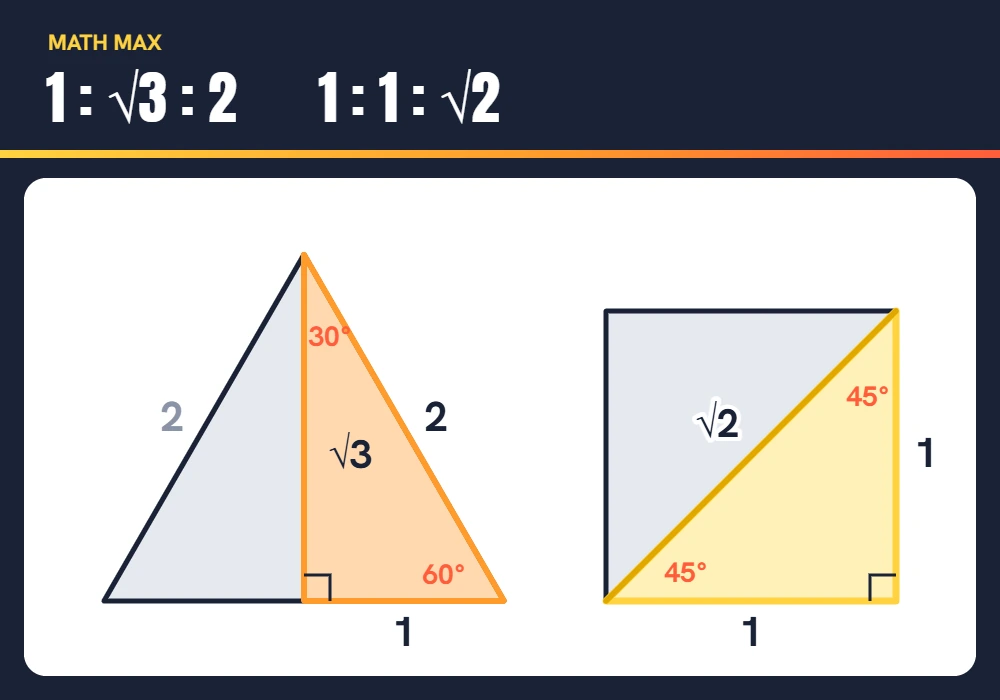
This picture also explains why the hypotenuse is exactly twice the short leg. The short leg is half of one side of the equilateral triangle, and the hypotenuse is a whole side. Every 30-60-90 triangle is a scaled copy of this one, so the ratio 1 : √3 : 2 holds for all of them.
How can you remember the 30-60-90 ratio?
Write the sides as the square roots √1, √3 and √4. The numbers under the roots are 1, 3 and 4, and √4 is just 2. The smallest root goes with the smallest angle, 30°, and the largest goes with the right angle. Drawing the half equilateral triangle takes a few seconds and is the safest memory aid of all.
How do you find the sides of a 45-45-90 triangle?
In a 45-45-90 triangle, the two legs are equal. Call each leg x. The hypotenuse is then x√2. So you multiply a leg by √2 to get the hypotenuse, and divide the hypotenuse by √2 to get a leg. The ratio of the sides is 1 : 1 : √2.
Example when you know a leg
Each leg is 7. The hypotenuse is 7 × √2 = 7√2, which is about 9.90.
Example when you know the hypotenuse
The hypotenuse is 10. Each leg is 10 ÷ √2 = 10√2/2 = 5√2, which is about 7.07.
Why is a 45-45-90 triangle half of a square?
Cut a square along its diagonal and you get two 45-45-90 triangles. The two legs are sides of the square, so they are equal, and the diagonal is the hypotenuse. For a square with sides of 1, the Pythagorean theorem gives 1² + 1² = 2, so the diagonal is √2. That is the right half of the diagram.
This is also why the diagonal of any square is its side times √2. A square tile with sides of 30 cm has a diagonal of 30√2, which is about 42.4 cm.
Which side is which in a special right triangle?
The longest side is always the hypotenuse, opposite the right angle. The shortest side is always opposite the smallest angle. In a 30-60-90 triangle that makes the order short leg, long leg, hypotenuse, which matches 1, √3 and 2, because √3 is about 1.73 and sits between 1 and 2.
Example
A triangle has angles of 30°, 60° and 90° and a side of 8 opposite the 60° angle. That side is the long leg, so the short leg is 8 ÷ √3 = 8√3/3, about 4.62, and the hypotenuse is twice that, 16√3/3, about 9.24.
The most common mistake is to put the 2 opposite the 60° angle because 60 is larger than 30. The 2 always belongs to the hypotenuse. Another frequent slip is to use √2 in a 30-60-90 triangle or √3 in a 45-45-90 triangle. A quick check helps. The hypotenuse must be the longest side, and the angles tell you which triangle you have.
Not every triangle with a 30° or 60° angle is special. The rule only works when the triangle also has a right angle. A triangle with angles of 30°, 60° and 90° is special, but a triangle with angles of 30°, 30° and 120° needs other methods.
What is the area of a 30-60-90 triangle?
The area is half of the two legs multiplied together, because the legs meet at the right angle. With a short leg of x, the area is x × x√3 ÷ 2. For a short leg of 4, that is 4 × 4√3 ÷ 2 = 8√3, about 13.86 square units.
How do special right triangles connect to sine, cosine and tangent?
Special right triangles give the exact trigonometry values for 30°, 45° and 60°. Sine is the opposite side divided by the hypotenuse, so in a 30-60-90 triangle, sin 30° = 1/2 and sin 60° = √3/2. In a 45-45-90 triangle, sin 45° = cos 45° = √2/2, and tan 45° = 1, because the two legs are equal.
Example
Use the triangle with sides 1, √3 and 2.
- sin 30° = 1/2, the short leg over the hypotenuse.
- cos 30° = √3/2, the long leg over the hypotenuse.
- tan 30° = 1/√3 = √3/3, the short leg over the long leg.
- tan 60° = √3/1 = √3, the long leg over the short leg.
The free textbook Precalculus 2e from OpenStax gives these same side lengths for both triangles and uses them to find the exact values of sine and cosine. The same numbers appear as coordinates on the unit circle, where the hypotenuse is scaled down to 1. That is why the unit circle and these triangles share the same values.
Reading these values quickly takes repetition. In the trigonometry game, every attack in a Math Max fight is a trig problem, and the geometry game is a natural next step for shape problems. Both are free to play in the browser, and a few rounds help the two ratios stick.

Why do the answers have square roots in them?
The exact sides involve √2 and √3, which are not whole numbers. Writing 5√3 keeps the answer exact, while 8.66 is a rounded value. Most teachers want the exact form unless the question asks for a decimal. If you want to get quicker with roots, the square roots game is good practice. With a little practice, exact forms soon feel normal.
One side and the right ratio give you the whole triangle
For a 30-60-90 triangle, use 1 : √3 : 2, and for a 45-45-90 triangle, use 1 : 1 : √2. Find the side that matches 1 first, then multiply. If you forget a ratio, draw half an equilateral triangle or half a square, and the Pythagorean theorem gives it back in a few seconds.
Train these next