
How do you calculate the area of a circle?
To calculate the area of a circle, square the radius, which is the distance from the centre to the edge, and multiply the result by π, which is about 3.14. Write the answer in square units, such as cm² or m², because area measures a surface rather than a length.
Example
Find the area of a circle with a radius of 5 cm.
- Square the radius. 5 × 5 = 25
- Multiply by π. 25 × π ≈ 78.54
- Add square units. The area is about 78.54 cm²
You can also leave the answer as 25π cm². This exact form is common in later school years, because it avoids rounding.
Should you use 3.14 or the π button?
Either is fine, as long as you follow what the teacher or the question asks. π is an irrational number, so its decimals never end or repeat, as Britannica explains. Using 3.14 gives 25 × 3.14 = 78.5 cm², while the π button gives 78.54 cm². The small difference comes only from rounding π.
Common mistakes with the formula
The most common mistake is multiplying the radius by 2 instead of squaring it. For a radius of 5 cm, 5 × 2 = 10, but 5² = 25. Another slip is multiplying π by the radius first and then squaring the whole result. The order of operations says the power comes first, so square the radius before you multiply by π.
How do you find the area of a circle from the diameter?
To find the area from the diameter, halve the diameter to get the radius, then use A = πr². The diameter goes all the way across the circle through the centre, so it is twice the radius. In one step, the formula is A = πd² ÷ 4, which gives exactly the same answer.
Example
A circle has a diameter of 10 cm. Halve it to get a radius of 5 cm. Then 5² × π = 25π ≈ 78.54 cm².
With the one-step formula, 10² = 100, then 100 × π ÷ 4 = 25π ≈ 78.54 cm². Both routes agree.
A very common mistake is putting the diameter straight into πr². With 10 cm, that gives 100π ≈ 314.16 cm², which is four times too big. If an answer looks surprisingly large, check if you used the diameter by accident.
How do you find the area of a circle from the circumference?
To find the area from the circumference, first find the radius by dividing the circumference by 2π. Then use A = πr². The circumference is the distance around the circle, and it equals 2πr. If you prefer one step, the formula is A = C² ÷ (4π), where C is the circumference.
Example
A round flower bed has a circumference of 30 m. Find its area.
- Find the radius. 30 ÷ (2 × π) ≈ 4.77 m
- Find the area. Keep the full radius in the calculator. π × 4.7746² ≈ 71.6 m²
- Check with the one-step formula. 30² ÷ (4 × π) = 900 ÷ 12.566 ≈ 71.6 m²
If you round the radius to 4.77 first, you get π × 4.77² ≈ 71.5 m² instead. That small gap is why it is best to round only at the very end.
Why is the area of a circle πr²?
Cut a circle into many equal slices, like a pizza, and lay them in a row, pointing up and down in turn. The slices form a shape that is almost a rectangle. Its height is the radius, r, and its length is half the circumference, πr. So its area is πr × r, which is πr².
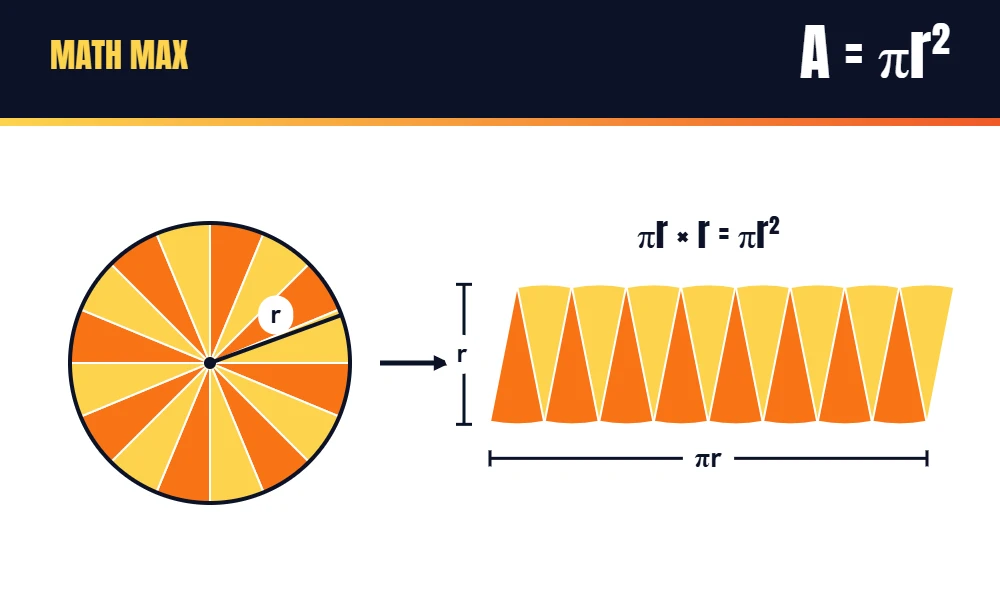
Example
Picture a circle with a radius of 5 cm cut into 16 slices. Half the slices point up and half point down. The row is as long as half the circumference, π × 5 ≈ 15.7 cm, and as tall as the radius, 5 cm. So the area is about 15.7 × 5 ≈ 78.5 cm², matching the formula.
With only 16 slices the edges are still a little wavy. With 100 or 1,000 slices, the shape gets closer and closer to a perfect rectangle. That is the idea behind the formula, and it is far easier to remember than the formula alone.
The Greek mathematician Archimedes worked on this problem over 2,000 years ago. Britannica describes how he proved that the area of a circle divided by the square of its radius is always the same number, and how he used polygons inside and outside a circle to show that π lies between 223/71 and 22/7.
A quick way to check your answer
A circle fits exactly inside a square whose sides are as long as the diameter. That square has an area of 2r × 2r = 4r². The circle covers a bit more than three quarters of it, about 78.5 %, because π ÷ 4 ≈ 0.785. So if a circle with a radius of 5 cm sits in a 10 cm square of 100 cm², its area should be a little under 80 cm². It is 78.54 cm².

The formula sticks best when you use it often, with different numbers. In the geometry game, each attack in a fight is a shape question, so recalling πr² quickly becomes part of winning a round. In the game π counts as 3, so every answer is a whole number you can work out in your head. Short, frequent rounds work better than one long session.
How do you find the radius when you know the area?
To find the radius from the area, work backwards through the formula. Divide the area by π, then take the square root of the result. As a formula, that is r = √(A ÷ π). Double the radius if you need the diameter instead.
Example
A circle has an area of 50 cm². Divide by π. 50 ÷ π ≈ 15.92. Then take the square root. √15.92 ≈ 3.99, so the radius is about 3.99 cm and the diameter is about 7.98 cm.
To check, put the radius back into the formula. π × 3.99² ≈ 50.0 cm². If your square roots feel rusty, a few rounds of square roots make this step much faster.
Is one big pizza bigger than two small ones?
Often, yes. Because the radius is squared, doubling the diameter of a circle makes its area four times as large. A pizza with a diameter of 30 cm has an area of about 707 cm². Two pizzas with a diameter of 20 cm have about 628 cm² together, so the single large pizza gives you more.
Example
For the 30 cm pizza, the radius is 15 cm, so the area is π × 15² ≈ 706.9 cm². For one 20 cm pizza, the radius is 10 cm, so the area is π × 10² ≈ 314.2 cm². Two of them make about 628.3 cm², roughly 79 cm² less than the single large pizza.
This kind of comparison is a great way to show children why squaring matters. A circle that is only a little wider covers a lot more surface.
What is the area of a semicircle?
A semicircle is half a circle, so its area is half of πr², or πr² ÷ 2. For a semicircle with a radius of 5 cm, the area is 25π ÷ 2 ≈ 39.27 cm². Remember to use the radius, not the length of the straight edge, which is the diameter.
Find the radius first, and the rest follows
Almost every circle area question becomes easy once you know the radius. Use this list to choose the right first step.
- Given the radius r: A = πr²
- Given the diameter d: r = d ÷ 2, or A = πd² ÷ 4
- Given the circumference C: r = C ÷ (2π), or A = C² ÷ (4π)
- Given the area, to find the radius: r = √(A ÷ π)
- Semicircle: A = πr² ÷ 2
Write the units as squared units at the end, and use the square check to see whether the answer is about the right size.
Train these next