
How do you find the circumference from the radius or diameter?
To find the circumference of a circle, multiply the diameter by π, about 3.14, so C = πd. The diameter is the distance straight across through the centre. If you only know the radius, the distance from the centre to the edge, double it first or use C = 2πr. Both routes give the same length.
Example
Find the circumference of a circle with a radius of 4 cm.
- Double the radius to get the diameter. 2 × 4 = 8 cm
- Multiply by π. 8 × π ≈ 25.13
- Add the unit. The circumference is about 25.13 cm
You can also leave the answer as 8π cm. This exact form is common in later school years, because it avoids rounding.
With the diameter, it takes one step. A round table with a diameter of 1.2 m has a circumference of 1.2 × π ≈ 3.77 m, so a strip of trim for its edge needs to be a little under 4 m long.
Should you use 3.14 or the π button?
Either is fine, as long as you follow what the question asks. π is irrational, so its decimals never end or repeat, and Britannica notes that 3.14 or 22/7 are the usual everyday approximations. With 3.14, the first example gives 8 × 3.14 = 25.12 cm. With the π button, it gives 25.13 cm. The small gap comes only from rounding π.
The most common mistake
The slip that costs the most points is putting the diameter into C = 2πr. With a diameter of 10 cm, that gives 2 × π × 10 ≈ 62.83 cm, which is twice too big. The right answer is 10 × π ≈ 31.42 cm. If you have the diameter, use πd. If you have the radius, use 2πr.
Why is the circumference π times the diameter?
π is defined as the circumference of a circle divided by its diameter. Every circle, from a coin to a planet, has the same shape, so this ratio never changes. That is why C = πd works for every circle. Roll a circle along a line for one full turn, and it covers just over three diameters.
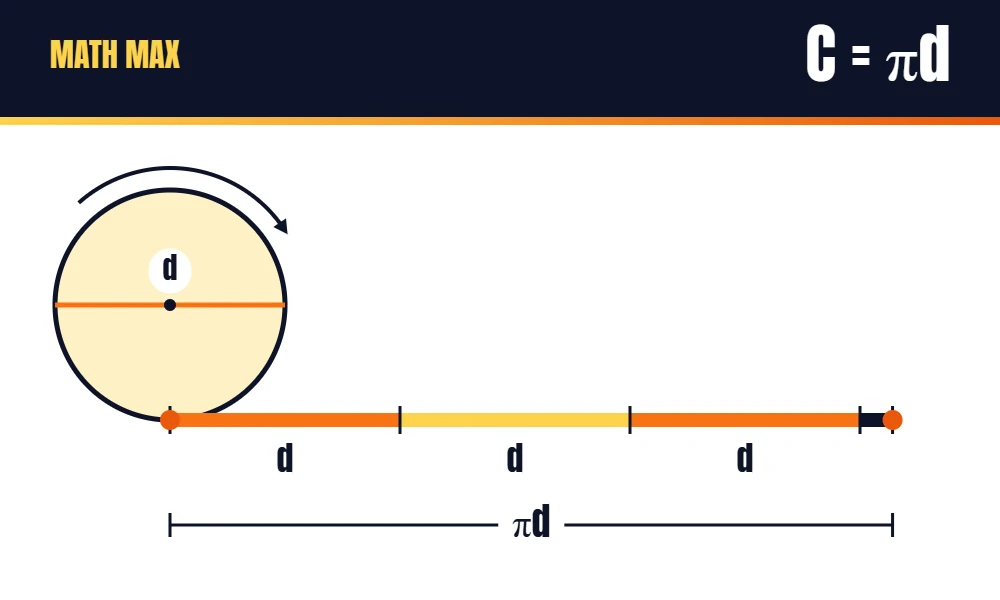
Example
Picture a coin with a diameter of 2 cm. Mark a point on its edge, then roll it along a ruler for exactly one turn. The mark comes back down at about 6.28 cm, because 2 × π ≈ 6.28. Three diameters make 6 cm, and the small extra piece is the 0.28 cm that turns 3 into 3.14.
You can test this at home with a round tin, a piece of string and a ruler, or with any round object and a tape measure. Measure the circumference and the diameter, then divide one by the other. The result is always close to 3.14, and the small errors come from measuring by hand.
The Greek letter π was first used for this ratio by William Jones in 1706, according to Britannica. The same entry describes how Archimedes trapped π between 223/71 and 22/7 by drawing polygons inside and outside a circle.
How do you find the diameter or radius from the circumference?
To find the diameter from the circumference, divide the circumference by π, so d = C ÷ π. To find the radius, divide by 2π instead, so r = C ÷ (2π). This works because the circumference formula is simply run backwards. Measure the distance around, and the size across follows.
Example
A tree trunk measures 150 cm around. Its diameter is 150 ÷ π ≈ 47.75 cm, and its radius is half of that, about 23.87 cm.
This is a handy trick for anything you cannot measure straight across, such as a tree, a pillar or a pipe. A tape measure around the outside, followed by one division, gives you the diameter.
How do you find the circumference from the area?
To find the circumference from the area, first find the radius. Divide the area by π, then take the square root, so r = √(A ÷ π). Then use C = 2πr. Keep the full radius in the calculator and round only at the end, so that small rounding errors do not add up.
Example
A circle has an area of 100 cm².
- Find the radius. 100 ÷ π ≈ 31.83, and √31.83 ≈ 5.64 cm
- Find the circumference. 2 × π × 5.642 ≈ 35.45 cm
There is also a one-step formula, C = 2√(πA). With 100 cm², that gives 2 × √(π × 100) ≈ 35.45 cm, the same answer. If square roots feel slow, a few rounds of square roots make this step much quicker.
How far does a wheel travel in one turn?
A wheel travels one circumference every time it turns once, as long as it rolls without slipping. So the distance for one turn is π times the wheel's diameter. A bicycle wheel with a diameter of 70 cm moves about 2.2 m per turn, and 1,000 turns carry it about 2.2 km.
Example
For the 70 cm wheel, one turn is 70 × π ≈ 219.9 cm, or about 2.2 m. To ride 1 km, which is 100,000 cm, the wheel turns 100,000 ÷ 219.9 ≈ 455 times.
This is exactly how many bike computers and step counters estimate distance. They count turns or steps and multiply by a known length. It is also a nice way to show children that π is not just a school number.

The formula sticks best when you use it often, with different numbers. In the geometry game, each attack in a fight is a shape question, so recalling C = πd quickly becomes part of winning a round. In the game π counts as 3, so every answer is a whole number you can work out in your head. Short, frequent rounds work better than one long session.
What is the perimeter of a semicircle?
The perimeter of a semicircle is half the circumference plus the straight edge, so P = πr + 2r. A common mistake is to stop at πr and forget the diameter along the bottom. For a radius of 5 cm, the curved part is 5π ≈ 15.71 cm, and adding 10 cm gives about 25.71 cm.
How is the circumference linked to the unit circle?
A unit circle has a radius of 1, so its circumference is exactly 2π. That is why one full turn is 2π radians in trigonometry. The unit circle uses this idea to measure angles as distances around the edge.
Know the radius or the diameter, and the circumference follows
Almost every circumference question becomes one multiplication once you know the radius or the diameter. Use this list to choose the right step.
- Given the radius r: C = 2πr
- Given the diameter d: C = πd
- Given the circumference, to find the diameter: d = C ÷ π
- Given the circumference, to find the radius: r = C ÷ (2π)
- Given the area A: r = √(A ÷ π), then C = 2πr
- Semicircle: P = πr + 2r
The answer is always a length, so write it in cm, m or another length unit, never in square units.
Train these next