
If you're reading this, you've probably watched your child stare at a sum that should be easy and simply not see it. That's worrying. Most children who find math hard don't have dyscalculia, though, and the ones who do can be helped a lot. Here is how to tell the difference, and what to do next.
What are the signs of dyscalculia at different ages?
Dyscalculia shows up as a weak feel for numbers. A child might count three objects one by one every time, not know whether 7 or 9 is bigger, or forget a fact like 4 + 5 the day after learning it. One sign alone means little. Several signs that last for months, despite good teaching, are what to look for.
The British Dyslexia Association calls dyscalculia the most severe form of math learning difficulty. Because it is about understanding numbers themselves, the signs change as school math changes.
Ages 3 to 5
In the years before school, the early signs listed by the Cleveland Clinic are mostly about counting and amounts.
- Trouble counting up in order
- Not linking a number to that many things, such as the number 4 to four marbles
- Not recognizing written numbers
- Trouble putting numbers in order from small to big
Try this at home. Put three buttons on the table and ask how many there are. Lots of children just see "three" without counting. A child who still has to touch each button, month after month, is showing one of the signs on that list.
Ages 6 to 11
This is when most parents first notice something. The signs often draw attention once children start school, around age 6.
- Using fingers for tiny sums like 2 + 3, long after classmates have stopped
- Forgetting basic facts and the times tables, however often they practice
- Mixing up +, −, × and ÷
- Struggling to tell the time on a clock with hands
- Finding it hard to count money or work out change
Finger counting is normal for young children, so don't panic about that one on its own. It only becomes a sign when it is still the only way your child can add very small numbers, at an age when that no longer seems necessary.
Teens and adults
In older children the trouble moves into daily life. Think of paying in a shop and checking the change, measuring for a recipe, reading a graph, or keeping track of time. Some teens freeze when a teacher asks them a math question in front of the class.
How common is dyscalculia?
Experts estimate that dyscalculia affects about 3 to 7 percent of people. In a class of 30, that is one or two children. General difficulty with math is far more common, which is the reassuring part. Most children who struggle with numbers have a gap that can be filled, not a lasting learning difficulty.
The British Dyslexia Association puts the figure at around 6 percent. It also says that around 1 in 4 people in the UK have difficulties learning math. That gap between 1 in 4 and 6 in 100 explains why so many parents worry and why most of them turn out to be dealing with something more ordinary.
So it's fine to keep an eye out without assuming the worst. Knowing the signs matters for the few children who do have dyscalculia, because they benefit most from getting help early.
Is it dyscalculia or just struggling with math?
Dyscalculia doesn't go away with more practice of the usual kind. A child who is simply behind, perhaps after missing a topic or moving schools, usually catches up once the gap is filled. If good teaching and regular practice change very little over months, ask for an assessment, because only a trained assessor can really tell the two apart.
Dyscalculia has nothing to do with intelligence or effort. Understood, a nonprofit for people who learn differently, is clear on that point. Many children with dyscalculia are quick and curious in other subjects. That contrast is exactly what confuses parents, especially when the school says results are "within the normal range".
What about math anxiety?
Math anxiety is fear of math. It can make a capable child freeze, guess or refuse to try, so it can look a lot like dyscalculia from the outside. A child can also have both, since anxiety is one of the conditions that often comes with dyscalculia. If your child gets very upset around numbers, tell the teacher or assessor, so they can see how much is worry and how much is the numbers themselves.
Dyslexia and ADHD
Dyscalculia often appears together with dyslexia or ADHD, Understood notes. Many parents find that the support their child gets at school focuses on reading and spelling, and math gets left out. If your child already has help for dyslexia or ADHD, ask whether math is part of the plan.
How is dyscalculia diagnosed?
There is no blood test or scan for dyscalculia. A trained assessor works it out by testing math skills, number sense and memory, and by ruling out other causes. Who does this depends on the country. In the UK it is a specialist teacher assessor, while elsewhere it may be a psychologist or a school service.
A sensible order looks like this.
- Talk to the teacher first. Ask what they see in class and whether the school can give extra help.
- Keep notes for a few weeks. Which tasks are hard? How long does homework take? How does your child feel about numbers?
- Be careful with online tests and screeners. The British Dyslexia Association points out that a screener can't diagnose dyscalculia. It can only suggest that a full assessment makes sense.
- Ask for a full assessment if things don't improve. Your school or your child's doctor can tell you who does this where you live.
You don't need a diagnosis before help can start. In the UK, the British Dyslexia Association says a child doesn't need a diagnosis to get support, and schools have a duty to make adjustments. Private assessments can be expensive, so it's fair to ask the school first what a diagnosis would change for your child.
What helps a child with dyscalculia?
Children with dyscalculia do best with teaching aimed at exactly the skills they find hard, step by step, often one to one or in a small group. There is no cure, but the right support helps, and it helps most when it starts early.
The Cleveland Clinic describes support as one-to-one learning programs built around what the child finds hardest. Understood puts it simply. The earlier kids with dyscalculia get help, the better.
At school, the British Dyslexia Association suggests adjustments such as these.
- A number line or a times table chart on the desk
- Counters, blocks and other objects to work with
- Extra time on math tasks and tests
- A calculator for some work
- Time with a teaching assistant, alone or in a small group
At home, the most useful thing you can do is take the pressure off. Keep math moments short and calm. Count stairs, share out grapes, set the table for six. Dice, dominoes and card games give lots of chances to ask "how many?" and "which is more?" without it feeling like homework. Praise the way your child worked something out, not how fast they were, and never compare them with a brother, sister or classmate.
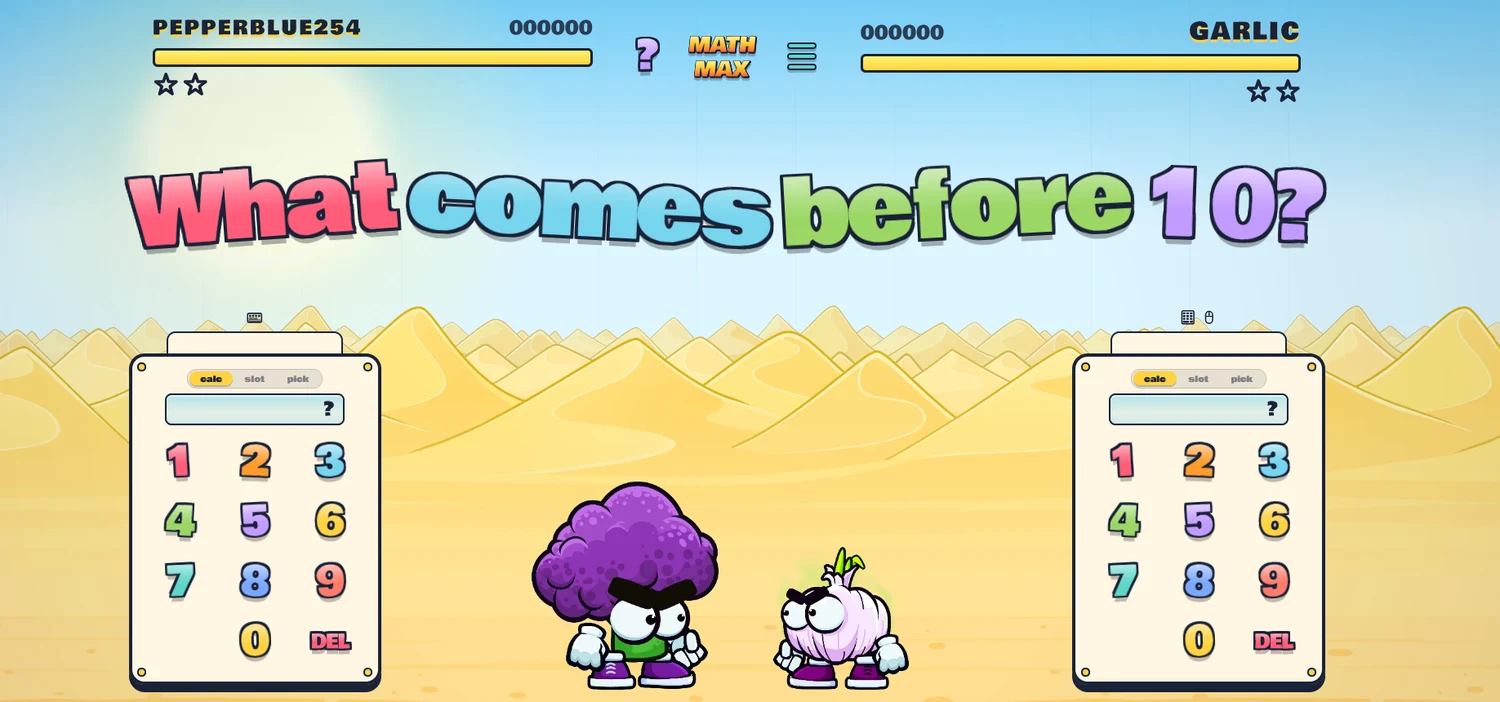
Games help for the same reason. In Math Max, every attack in a fight is a math problem, so a child solves sums because they want their fighter to win, not because a worksheet says so. The comparing numbers game works on which number is bigger, and the number bonds game on pairs that make a total, like 3 and 7 making 10. The fight below asks what comes before 10, the same kind of number-order question as in the signs above. Use it as relaxed play next to the school's support, not instead of it.
Can teens and adults have dyscalculia?
Yes. Dyscalculia is lifelong, so a teenager doesn't grow out of it. Money, time, budgets and estimating distances are where it usually shows. Teens and adults can be assessed too, so it is never too late to find out. A teen who has always found numbers hard has good reason to ask.
For teens, look for a mix of math trouble and practical trouble. Freezing in math lessons, often running late and losing track of money are typical. These are worth raising with the school even when other subjects are going well.
Adults with dyscalculia often lean on simple tools, such as a calculator, a digital clock and a bit of extra time for number tasks at work. People who want to rebuild their math as adults often say it helped to go right back to the basics and understand why each method works.
If you've just heard the word dyscalculia for the first time, the future can feel scary. In parent forums, adults with dyscalculia often answer worried parents the same way. They found their own ways around it, and they built lives and careers they enjoy.
Getting the right help matters more than the label
If several signs fit and they've lasted for months, talk to the teacher and ask about an assessment. If only one or two fit, keep math at home short, calm and playful, and see how the next few months go.
Whatever the answer turns out to be, your child isn't lazy and isn't slow. Patient, hands-on help with numbers is good for any child who finds them hard.
Train these next