
How do you build the Fibonacci sequence?
To build the Fibonacci sequence, write down 0 and 1, then add the last two numbers to get the next one, and keep repeating that step. Each new number depends only on the two before it, so the list can go on forever. The numbers you write down this way are called Fibonacci numbers.
Example
Build the sequence step by step. Start with 0 and 1.
- 0 + 1 = 1
- 1 + 1 = 2
- 1 + 2 = 3
- 2 + 3 = 5
- 3 + 5 = 8
- 5 + 8 = 13
- 8 + 13 = 21
Each new number only needs the last two. That makes it a good mental-addition challenge for children, because the numbers grow quickly but the rule never changes. The rule is simple enough for a young child, yet the same numbers turn up in sunflowers, pine cones and the golden ratio.
Does the sequence start with 0 or 1?
Both versions are common. Many books start with 0, 1, 1, 2, 3, while others start with 1, 1, 2, 3. The numbers that follow are the same either way. Mathematicians usually write the rule as Fₙ = Fₙ₋₁ + Fₙ₋₂, with F₀ = 0 and F₁ = 1, which means "each term is the sum of the previous two".
Hidden patterns in the sequence
The sequence has small patterns that children enjoy finding. Every third number is even (0, 2, 8, 34, 144, 610), and all the others are odd. Every fifth number can be divided by 5 (0, 5, 55, 610). Ask a child to check these patterns further along the list. It is a fun way to practise addition and spot structure at the same time.
Where does the Fibonacci sequence come from?
The sequence is named after Leonardo of Pisa, known as Fibonacci, an Italian mathematician. He described it in his book Liber abaci, written in 1202, through a puzzle about rabbits. According to Britannica, it is the first recursive number sequence known in Europe, meaning each term is built from earlier terms.
Example
The rabbit puzzle works like this. You start with one newborn pair of rabbits. A pair needs one month to grow up, and from then on every adult pair produces one new pair each month. No rabbits ever leave. Count the pairs at the start of each month.
- Month 1: 1 pair (newborn)
- Month 2: 1 pair (now adult)
- Month 3: 2 pairs (the adults and their first babies)
- Month 4: 3 pairs
- Month 5: 5 pairs
- Month 6: 8 pairs
Each month's total is the previous total plus the number of adult pairs, and the adults are exactly the total from two months earlier. That is the Fibonacci rule. Real rabbits do not behave this neatly, of course. The puzzle was a way to describe the pattern, not a study of animals.
How do you find the next number in the Fibonacci sequence?
To find the next Fibonacci number, add the last two numbers in the list. After 21 and 34 comes 21 + 34 = 55, and after 34 and 55 comes 89. To find a number far along the sequence, keep a running list, or use Binet's formula, which calculates any term directly with the golden ratio.
Example
Find the 10th Fibonacci number, counting F₀ = 0 as the start. Writing out the list gives 0, 1, 1, 2, 3, 5, 8, 13, 21, 34, 55, so F₁₀ = 55.
Binet's formula gives the same answer without the list. Raise the golden ratio φ (about 1.618) to the 10th power and divide by √5. That gives about 122.99 ÷ 2.236 ≈ 55.004, and rounding to the nearest whole number gives 55. For older learners this is a nice surprise, because a number built from square roots lands so close to a whole number every time.
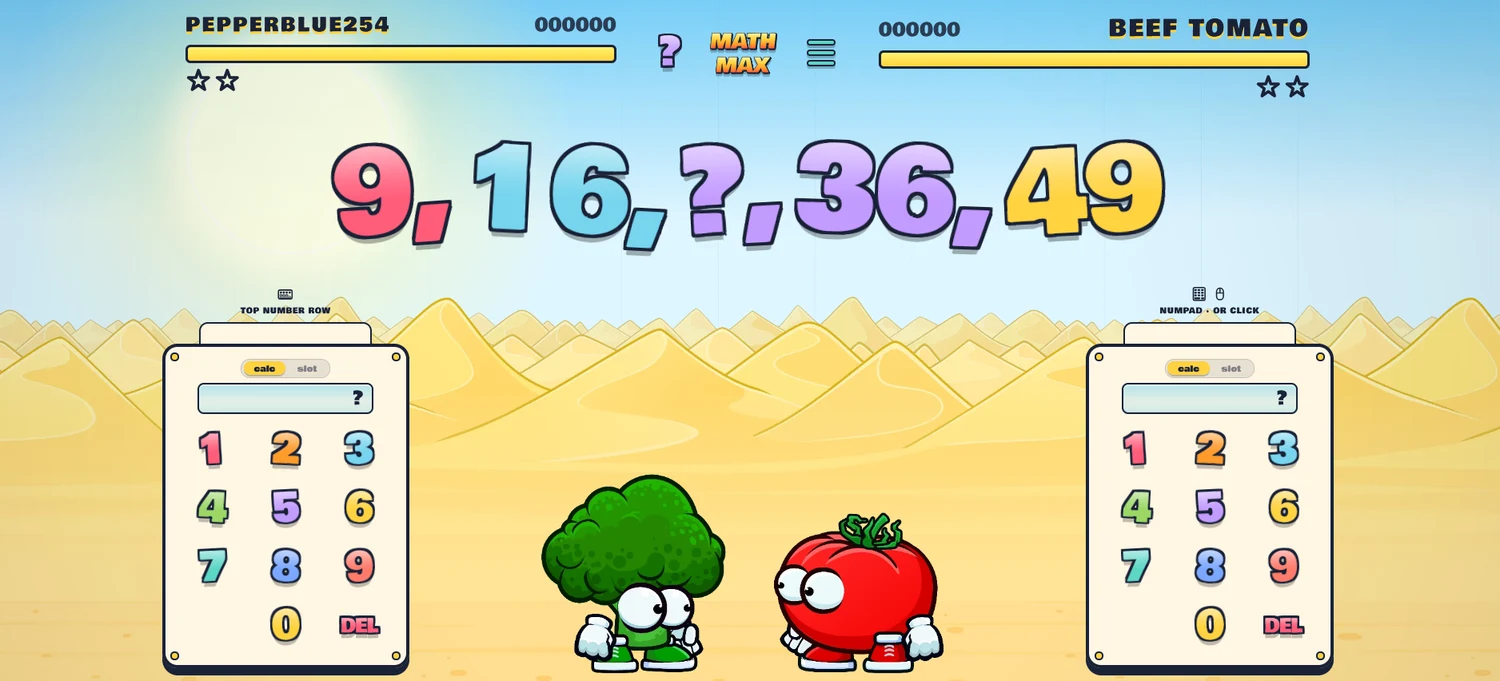
Spotting the rule behind a list of numbers is a skill that goes well beyond Fibonacci. The number sequences game turns it into a fight, where each attack is a sequence and you have to find the missing number. It is a quick way to practise seeing patterns like "add the last two" without writing anything down.
How is the Fibonacci sequence related to the golden ratio?
If you divide each Fibonacci number by the one before it, the answers get closer and closer to the golden ratio, about 1.618. For example, 8 ÷ 5 = 1.6, 13 ÷ 8 = 1.625 and 89 ÷ 55 ≈ 1.618. The golden ratio itself is (1 + √5) ÷ 2, a number whose decimals never end or repeat.
Example
Watch the ratios settle down as the numbers grow.
- 3 ÷ 2 = 1.5
- 5 ÷ 3 ≈ 1.667
- 8 ÷ 5 = 1.6
- 13 ÷ 8 = 1.625
- 21 ÷ 13 ≈ 1.615
- 34 ÷ 21 ≈ 1.619
- 55 ÷ 34 ≈ 1.618
The answers bounce above and below 1.618, getting closer each time. Britannica notes that this link was described by the mathematician Robert Simson in 1753.
What is the Fibonacci spiral?
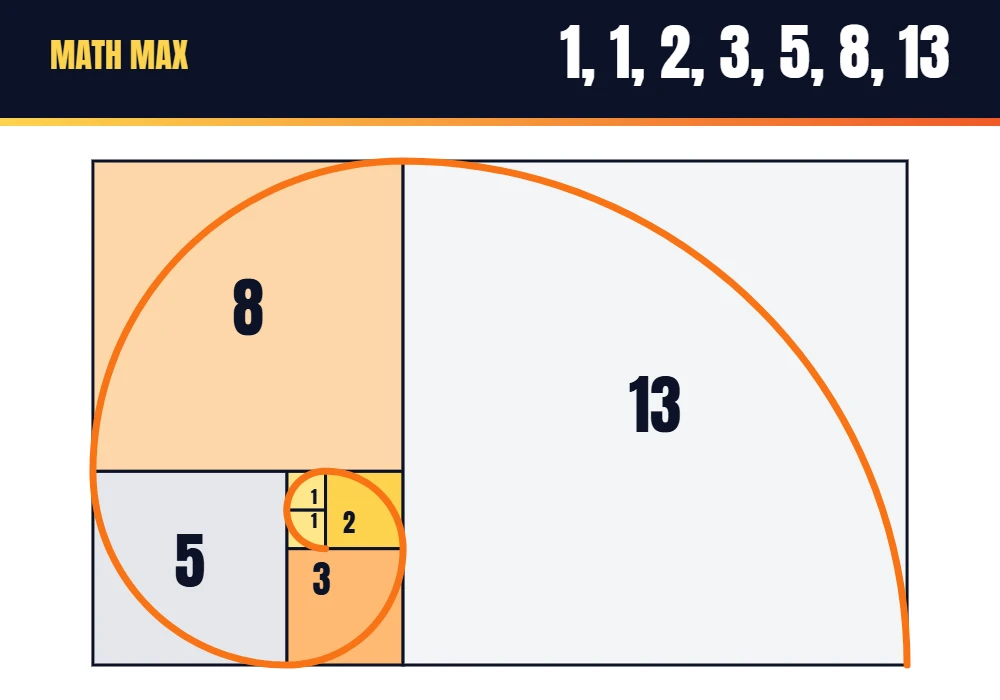
Draw a square with sides of 1, then another square of 1 next to it, then a square of 2, then 3, then 5, then 8, each one placed against the rectangle you have so far. Connect opposite corners of each square with a quarter circle and you get the Fibonacci spiral. It is a close approximation of the golden spiral, which grows by the golden ratio at every quarter turn.
Where does the Fibonacci sequence show up in nature?
Fibonacci numbers often appear in plants. The seeds of a sunflower form two sets of spirals, and the number of spirals in each direction is usually a pair of neighbouring Fibonacci numbers, such as 34 and 55 or 55 and 89. Pine cones show similar spirals, and many flowers have 3, 5, 8, 13 or 21 petals.
Example
Take a pine cone or a picture of a sunflower and count the spirals that curve clockwise. Then count the spirals that curve the other way. The Fibonacci in nature pages by Dr Ron Knott at the University of Surrey show sunflowers with 55 spirals one way and 34 the other, and larger ones with 89 and 55.
The same pages list flowers by petal count, such as delphiniums with 8, ragwort and some daisies with 13, and asters with 21. Counting together is a lovely hands-on activity, and it shows children that numbers describe real things around them.
Why do plants grow in Fibonacci spirals?
Many plants place each new seed or leaf at roughly the same turning angle from the last one, about 137.5°. This angle, linked to the golden ratio, packs seeds closely with no wasted gaps, and the spirals you can count are a side effect of that steady turning. The second part of Ron Knott's guide shows why this angle works so well.
Is the Fibonacci sequence really everywhere in nature?
No. Fibonacci numbers are common in plants, but they are not a law of nature. Ron Knott's Surrey pages point out that you will not always find Fibonacci numbers in petals or seed heads, and some flowers, such as fuchsias, have 4 petals. Many claims online, especially about shells, faces and famous buildings, stretch the evidence too far.
Example
The nautilus shell is often shown with a golden spiral drawn over it. The shell does grow in a logarithmic spiral, a curve that keeps the same shape as it gets bigger. But Knott's pages note that its growth factor varies and may not be the golden ratio, and that calling it a golden spiral is incorrect. So the nautilus is a beautiful spiral, just not proof of Fibonacci.
This is a useful lesson for older children too. A pattern that shows up often is worth noticing, but the honest question is always "how often, and how closely?" Counting the spirals on a real pine cone is a better test than any picture online.
Two starting numbers and one rule build the whole sequence
Every Fibonacci number comes from the same step, adding the two numbers before it. Here are the first 21 terms, starting from F₀ = 0, so you can check your own list.
- 0, 1, 1, 2, 3, 5, 8, 13, 21, 34
- 55, 89, 144, 233, 377, 610, 987
- 1,597, 2,584, 4,181, 6,765
If a child loses track, go back to the last two numbers they are sure of and add again. The rule never changes, so one mistake is always easy to repair.
Train these next