The midpoint of a line segment
You add the two x-coordinates and halve the sum, then do the same with the two y-coordinates. In other words, the midpoint is simply the average of the two endpoints.
The same idea works on a number line, in three dimensions and backwards, when you know the midpoint and need the missing endpoint. Below you will find each case with real numbers, plus the mistakes that trip people up most often.
How do you find the midpoint between two points?
To find the midpoint between two points, add the x-coordinates and divide by 2, then add the y-coordinates and divide by 2. The two results are the coordinates of the midpoint. Using the midpoint formula this way works for any two points on a coordinate grid, including points with negative or fractional coordinates.
Example
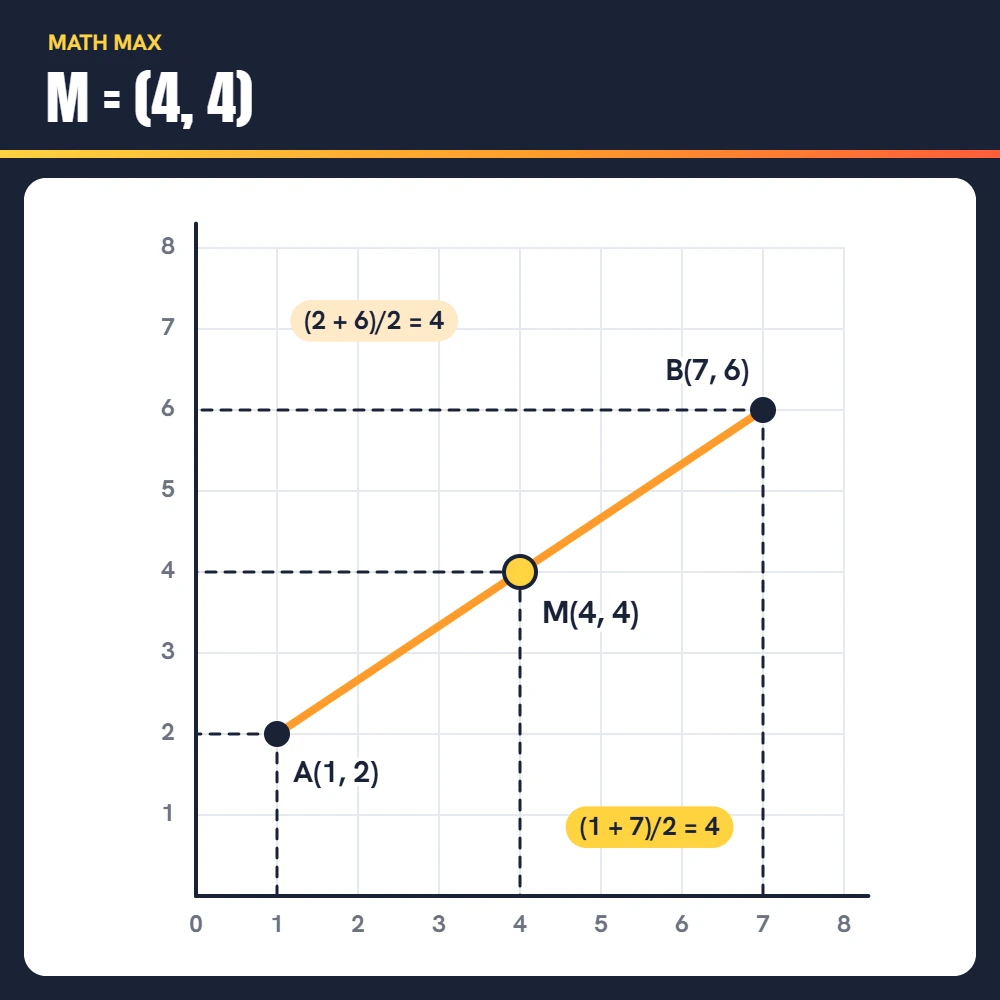
Find the midpoint of the segment from A(1, 2) to B(7, 6).
- Add the x-coordinates and halve the sum. (1 + 7)/2 = 8/2 = 4.
- Add the y-coordinates and halve the sum. (2 + 6)/2 = 8/2 = 4.
- Write the result as a point. The midpoint is M(4, 4).
The diagram below shows the same segment. Along the bottom, 4 sits exactly halfway between 1 and 7. Along the side, 4 sits exactly halfway between 2 and 6.
Why does the midpoint formula work?
Moving from A to B, you go 6 units to the right and 4 units up. The midpoint is where you have done exactly half of that trip, so 3 units to the right and 2 units up from A. That lands on (1 + 3, 2 + 2) = (4, 4), the same answer as the formula.
Halfway along the trip always means halfway along each direction separately. That is why the x-coordinates and the y-coordinates never mix in the midpoint formula. Each pair is averaged on its own.
Does the order of the points matter?
No. Addition does not care about order, so (7 + 1)/2 is the same as (1 + 7)/2. You can call either endpoint the first point and get the same midpoint. What does matter is that you keep each x with the other x and each y with the other y.
What do x₁, x₂, y₁ and y₂ mean in the midpoint formula?
The midpoint formula says that the midpoint M of the segment joining (x₁, y₁) and (x₂, y₂) is M = ((x₁ + x₂)/2, (y₁ + y₂)/2). The small numbers 1 and 2 only label the first and second point. The formula averages the x-coordinates and averages the y-coordinates, and nothing else.
Example with negative numbers
Find the midpoint of (−3, 5) and (5, −1).
- x-coordinate: (−3 + 5)/2 = 2/2 = 1
- y-coordinate: (5 + (−1))/2 = 4/2 = 2
The midpoint is (1, 2). Notice that a negative coordinate is added with its sign. Adding −1 is the same as subtracting 1.
Example where the answer is not a whole number
Find the midpoint of (2, 3) and (5, 8).
- x-coordinate: (2 + 5)/2 = 7/2 = 3.5
- y-coordinate: (3 + 8)/2 = 11/2 = 5.5
The midpoint is (3.5, 5.5). That is a perfectly good answer. A midpoint lands on a grid crossing only when both sums are even.
The college algebra course from Lumen Learning writes the formula in exactly this form and uses it to find the center of a circle, which you will also find further down. It is the standard form in most textbooks.
How do you find the midpoint on a number line?
On a number line, the midpoint of two numbers is their sum divided by 2. This is the one-dimensional version of the midpoint formula. The midpoint of 3 and 11 is (3 + 11)/2 = 7, and you can check it because 7 is 4 steps from each end.
Example
Find the number halfway between −4 and 10. The sum is −4 + 10 = 6, and 6/2 = 3. Counting along the number line confirms it, because from −4 to 3 is 7 steps and from 3 to 10 is also 7 steps.
This is a good way to introduce the idea to younger learners, around ages 10 to 12, before they meet coordinates. Halfway between two numbers is just their average, and a coordinate pair is two number lines at once.
How do you find a missing endpoint from the midpoint?
To find a missing endpoint, double the midpoint and subtract the known endpoint. Do this separately for x and for y. The missing x is 2 × (midpoint x) − (known x), and the missing y works the same way. This works because the midpoint sits the same distance from both ends.
Example
The midpoint of a segment is (2, −1), and one endpoint is (−3, 4). Find the other endpoint.
- x-coordinate: 2 × 2 − (−3) = 4 + 3 = 7.
- y-coordinate: 2 × (−1) − 4 = −2 − 4 = −6.
- The missing endpoint is (7, −6).
Check it with the midpoint formula. (−3 + 7)/2 = 2 and (4 + (−6))/2 = −1, which gives back the midpoint (2, −1).
There is also a step method that many learners find easier. From (−3, 4) to the midpoint (2, −1) you move 5 to the right and 5 down. Make the same move again from the midpoint, and you land on (7, −6).
How are the midpoint formula and the distance formula related?
The midpoint formula tells you where the middle of a segment is, while the distance formula tells you how long the segment is. They are often taught together because they use the same two points. The distance formula comes from the Pythagorean theorem, and the midpoint always cuts that distance into two equal halves.
Example
For A(1, 2) and B(7, 6), the segment goes 6 across and 4 up. By the Pythagorean theorem, its length is the square root of 6² + 4² = 52, which is about 7.21. This is the distance formula in action.
From A to the midpoint M(4, 4) you go 3 across and 2 up, so that distance is the square root of 3² + 2² = 13, about 3.61. That is exactly half of the whole length, which is a quick way to check that a midpoint is right.
How do you find the center of a circle from a diameter?
The center of a circle is the midpoint of any diameter. If a diameter runs from (−2, 1) to (4, 9), the center is ((−2 + 4)/2, (1 + 9)/2) = (1, 5). The diameter goes 6 across and 8 up, so it is 10 long, and the radius is 5.
The midpoint is also the first step for a perpendicular bisector, the line that cuts a segment in half at a right angle. You find the midpoint, then use the slope of the segment. The linear functions game is a good place to get quick with slopes and lines on a grid. Midpoints and slopes together are enough to write the bisector's equation.
What are the most common midpoint formula mistakes?
Most midpoint mistakes come from subtracting the coordinates instead of adding them, mixing an x-coordinate with a y-coordinate, dropping a minus sign or forgetting to halve. Each one gives a point that is not halfway. One quick check catches all of them, because the midpoint must sit between the two endpoints in both directions.
- Subtracting instead of adding. For (1, 2) and (7, 6), (7 − 1)/2 = 3 is half the distance across, not the midpoint. The midpoint is 1 + 3 = 4.
- Mixing coordinates. Adding 1 + 6 pairs the x of one point with the y of the other. Always pair x with x and y with y.
- Losing a sign. For −6 and 2, the sum is −4 and the midpoint is −2, not 4.
- Forgetting to halve. The sum (1 + 7) = 8 is not the midpoint. Divide by 2 every time.
A fast way to build the habit of averaging pairs in your head is to play a few rounds in the geometry game. Every attack in a Math Max fight is a quick math problem, so you get a lot of coordinate and shape practice in a short time, for free in the browser.

Can you use the midpoint formula in 3D?
Yes. In three dimensions a point has three coordinates, and you average each one in the same way. The midpoint of (x₁, y₁, z₁) and (x₂, y₂, z₂) is ((x₁ + x₂)/2, (y₁ + y₂)/2, (z₁ + z₂)/2). Nothing new is needed, because each direction is still handled on its own.
Example
The midpoint of (1, 2, 3) and (5, 6, 9) is ((1 + 5)/2, (2 + 6)/2, (3 + 9)/2) = (3, 4, 6).
The same averaging idea also gives the center of a rectangle on a grid. Take the midpoint of either diagonal. For a rectangle with corners (0, 0) and (8, 4) on one diagonal, the center is (4, 2).
The midpoint is always the average of the two endpoints
Every case above comes back to one move. Add the matching coordinates and halve them. That works on a number line, on a grid and in 3D, and running it backwards finds a missing endpoint. Finish with the check that the midpoint sits between the endpoints in every direction, and the answer will be right.
Train these next