If that sounds wrong to you, you're in good company. Thousands of people, some of them with a PhD, refused to believe it at first. Below is the puzzle, followed by a few different ways of seeing why switching works. One of them will probably make it click.
How does the Monty Hall problem work?
You're on a game show facing three closed doors. One hides a car, the other two hide goats. You pick a door. The host, who knows where the car is, opens one of the other two doors and shows you a goat. He asks whether you want to stay with your door or switch to the last closed one.
Most people shrug and say it doesn't matter. Two doors are left, so it must be 50-50. It isn't. Switching wins the car 2 times out of 3.
The puzzle is named after Monty Hall, who hosted the television game show Let's Make a Deal. The famous answer depends on three rules.
- The host always opens a door you didn't pick.
- The host always reveals a goat, never the car.
- The host always offers you the switch.
Why does switching win 2 out of 3 times?
Your first pick is wrong 2 times out of 3. Each time it's wrong, the host has no choice. He has to open the other goat door, which leaves the car behind the door you could switch to. So switching wins every time your first guess was wrong, and loses only when you happened to pick the car straight away.
Example
Say you always pick door 1. The car can only be in three places, and each is equally likely.
- The car is behind door 1. The host opens door 2 or door 3. Staying wins, switching loses.
- The car is behind door 2. The host has to open door 3. Staying loses, switching wins.
- The car is behind door 3. The host has to open door 2. Staying loses, switching wins.
Count them up. Staying wins once, switching wins twice. It works the same way whichever door you start with.
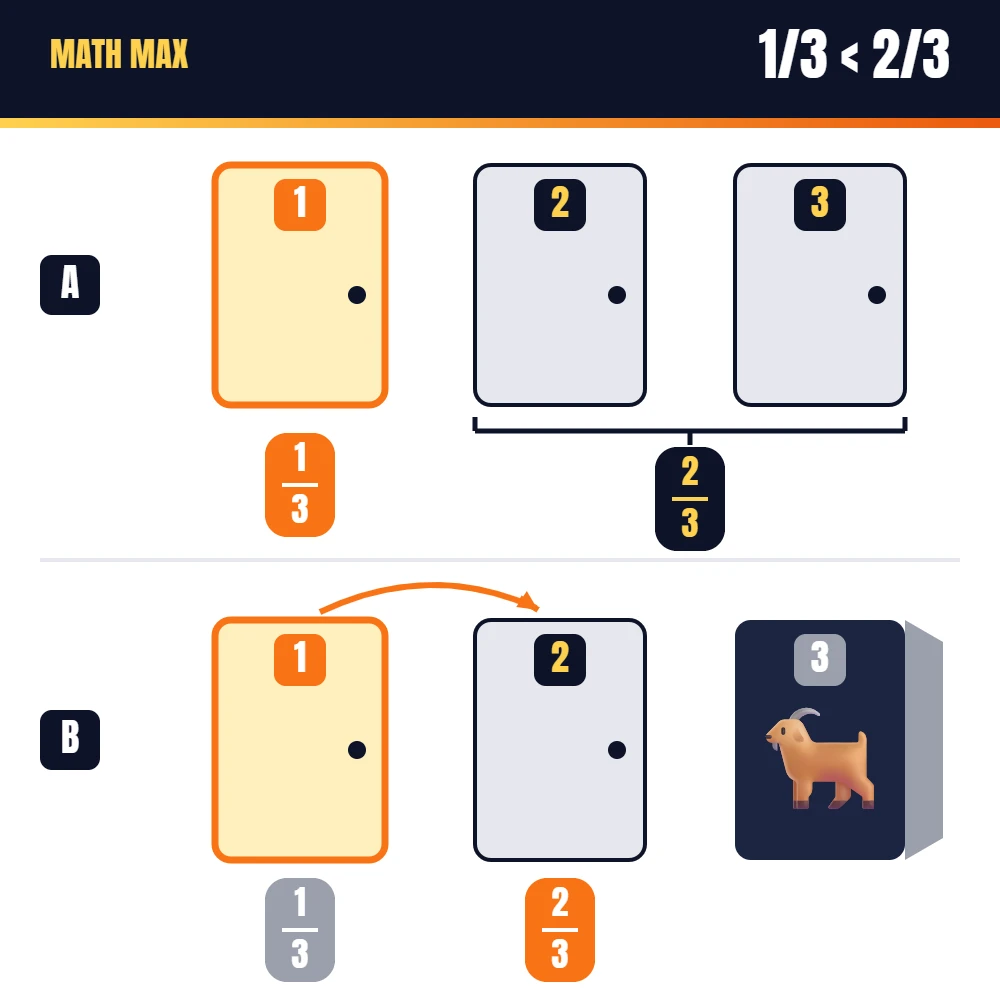
Here's another way to picture it. Your door starts with a 1 in 3 chance, and the other two doors share the remaining 2 in 3. When the host opens one of them, the car doesn't move. He's only showing you which of those two doors now holds the whole 2 in 3.
Why isn't it 50-50 when two doors are left?
Because the host doesn't open a door at random. He knows where the car is and always avoids it, so the door he leaves closed was chosen with that knowledge. Your own door was picked blind and keeps its 1 in 3 chance. The other closed door gets the rest, 2 in 3.
A Scientific American article on the puzzle puts the mistake down to something psychologists call equiprobability bias. We tend to assume that whatever outcomes are in front of us are equally likely. Two doors look like a coin toss, so we stop thinking.
The other trap is that the host's move seems to tell you nothing. It actually tells you a lot. Whenever your door hides a goat, the host is forced to leave the car door shut. That forced choice is the hidden information.
Does the 100 doors version make it easier?
For many people it does. Imagine 100 doors and one car. You pick one, and the host, who knows where the car is, opens 98 of the others to show 98 goats. One door stays shut. Your door had a 1 in 100 chance. The door the host carefully skipped now has the other 99 in 100.
Example
You pick door 37. The host opens every door from 1 to 100 except 37 and 82. Do you really think your random first pick was the lucky one? It's far more likely that he skipped door 82 because the car is behind it.
Marilyn vos Savant, who made the puzzle famous, used an even bigger version with a million doors. The idea is the same with three doors, just harder to feel. If 100 doors don't help you, try thinking about being wrong instead. Your first pick is wrong 2 times out of 3, and switching turns every wrong pick into a win.
What happens if the host doesn't know where the car is?
Then switching stops helping. If the host opens a door at random and it just happens to show a goat, staying and switching both win half the time. The 2 in 3 answer only holds when the host knows where the car is, always opens a goat door and always offers the switch.
Example
You pick door 1, and a host who doesn't know opens door 2 or door 3 at random. Sometimes he reveals the car by accident, and those games are spoiled. In the games where a goat appears, the car is behind your door exactly half the time.
The real Monty Hall pointed out the same catch. In a 1991 New York Times article, he warned that a contestant should beware if the host can choose whether to offer a switch at all. On a real show, the offer itself might be a trap.
How can you test the Monty Hall problem yourself?
You only need three playing cards and a friend. One ace is the car, two other cards are the goats. Your friend shuffles them face down, you point at one, and your friend turns over a goat you didn't pick. Play 30 rounds and always switch. You should win about 20 of them.
Then play another 30 rounds and always stay. This time you should win about 10. With so few rounds the numbers will wobble a bit, but the difference shows up quickly.
Even famous mathematicians needed to see it. Scientific American mentions that the prolific mathematician Paul Erdős was tripped up by the puzzle too. So if it still feels wrong, play the cards.
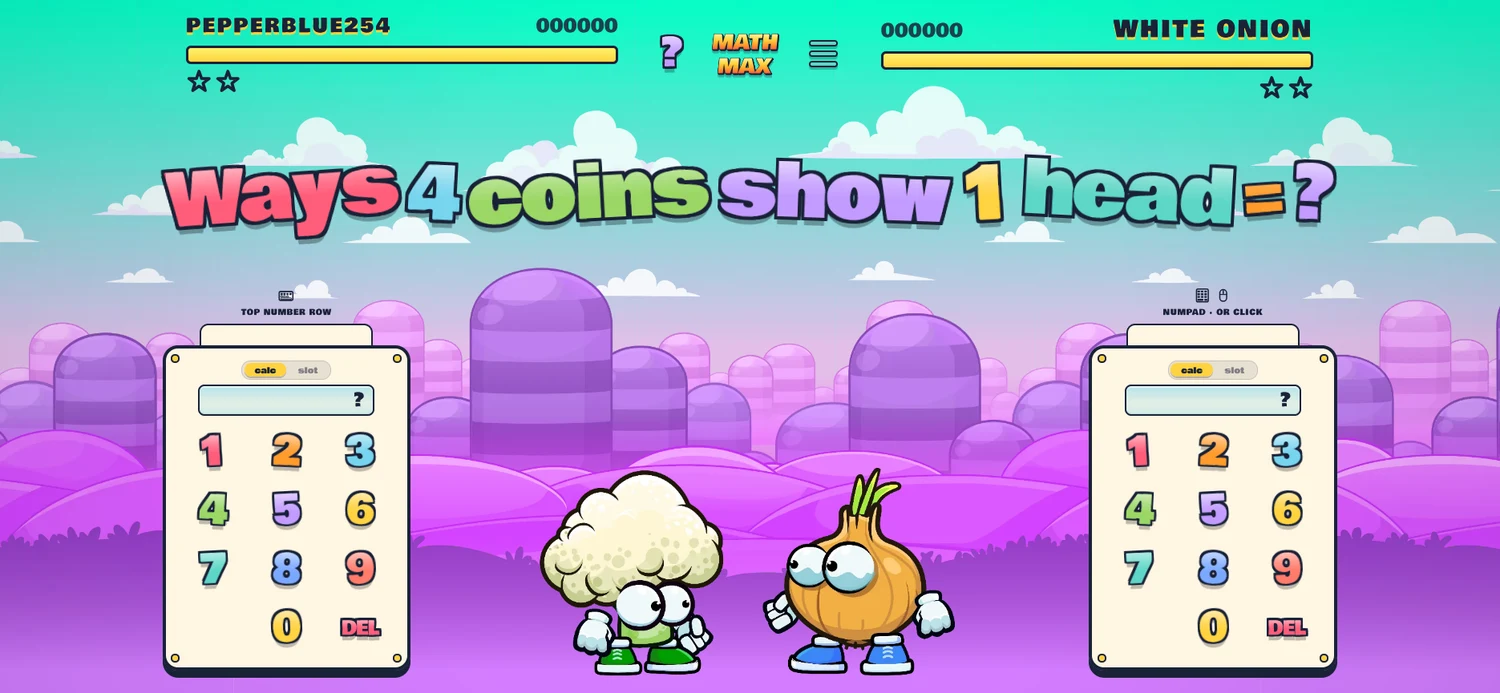
What the puzzle really trains is counting all the possible cases fairly. The probability game asks the same kind of question in every round. In the fight below, for example, you have to count the ways 4 coins can show exactly 1 head. The answer is 4, because the head can be on any one of the four coins.
Why do so many people get the Monty Hall problem wrong?
Two closed doors simply look like a 50-50 choice, and the host's hidden knowledge is easy to miss. Regret probably plays a part too. Losing after you switched away from the car feels worse than losing because you stayed, so many people stick with their first door even when they understand the math.
The puzzle first appeared in 1975, in letters by the statistician Steve Selvin. It became famous in 1990, when Marilyn vos Savant answered it in her Ask Marilyn column in Parade magazine and told readers to switch. Scientific American reports that she received an estimated 10,000 letters telling her she was wrong. The New York Times added that close to 1,000 of them were signed by people with a PhD.
She was right, of course. The letters are now part of the story, and they're the best reminder that a confident gut feeling about chance can be completely wrong.
Switch, as long as the host knows and always opens a goat door
Under the usual rules, switching doubles your chance of winning, from 1 in 3 to 2 in 3. Change the rules and the answer can change too, for example with a host who opens doors at random or only offers a switch when it suits him. That's the lesson that goes beyond game shows. Before you trust a probability, ask how the information in front of you was chosen.
Train these next