It tells everyone which part of a calculation to do first, so the same sum always gives the same answer. Below you'll find how to use it step by step, the left-to-right rule most people miss, how it compares with BODMAS and BIDMAS, and the viral puzzles that start arguments online.
How do you use PEMDAS step by step?
To use PEMDAS, work through a calculation in four rounds. First do everything inside parentheses, then exponents, then multiplication and division from left to right, and finally addition and subtraction from left to right. After each step, rewrite the whole expression so you can see what is left.
Example
Work out 3 + 4 × (6 − 2)² ÷ 8.
- Parentheses: 6 − 2 = 4, so you have 3 + 4 × 4² ÷ 8
- Exponents: 4² = 16, so you have 3 + 4 × 16 ÷ 8
- Multiplication and division, left to right: 4 × 16 = 64, then 64 ÷ 8 = 8, so you have 3 + 8
- Addition and subtraction: 3 + 8 = 11
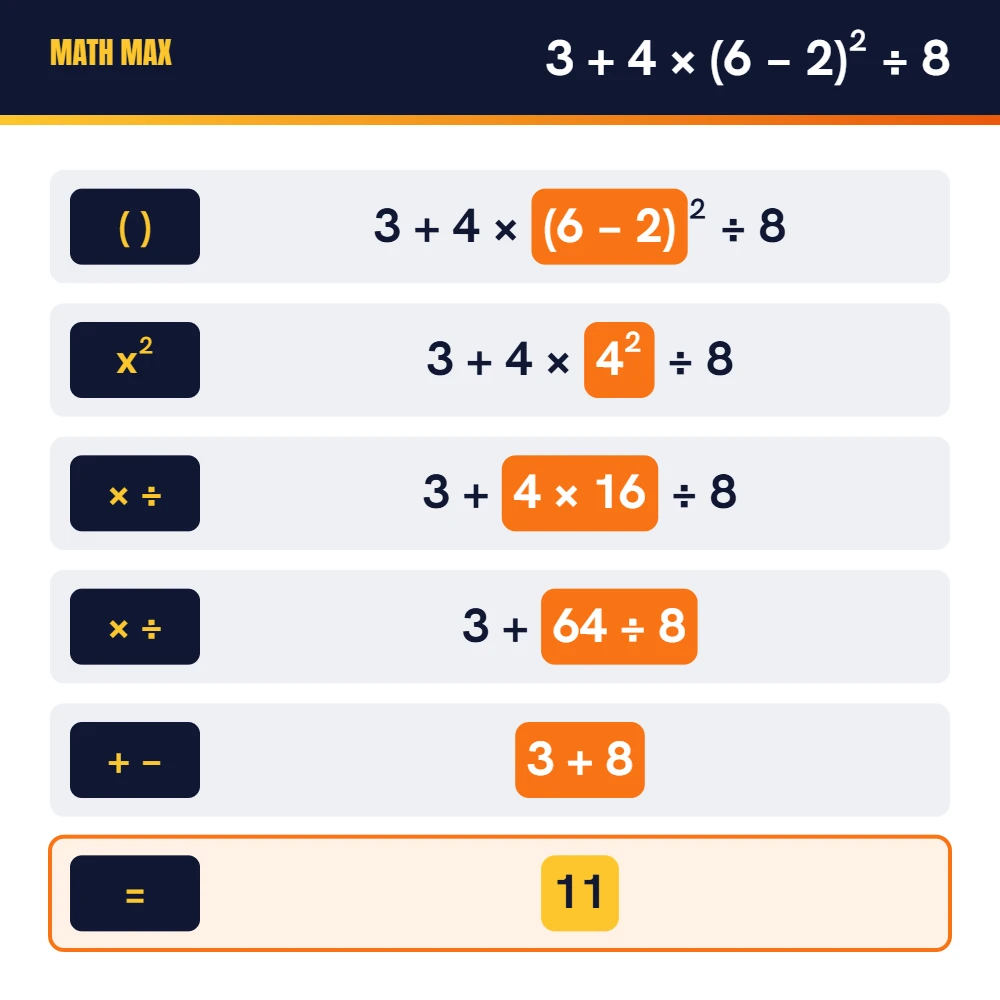
Rewriting the line after every step looks slow, but it's the habit that stops most mistakes. If you skip it, it's easy to add the 3 too early and get 3 + 4 = 7, which leads to a very different answer.
Does multiplication come before division in PEMDAS?
No. Multiplication and division have the same priority, and so do addition and subtraction. Within each pair, you work from left to right. The order of the letters in PEMDAS only reflects how the word is spelled, not a rule that M beats D or A beats S. It's one of the most common PEMDAS mistakes.
Example
Work out 24 ÷ 4 × 2.
- Left to right, the division comes first: 24 ÷ 4 = 6
- Then the multiplication: 6 × 2 = 12
If you multiply first, you get 24 ÷ 8 = 3, which is wrong. The same goes for 10 − 4 + 3. Left to right gives 6 + 3 = 9, while adding first gives 10 − 7 = 3, which is also wrong.
The open textbook OpenStax Prealgebra 2e states it clearly, saying multiplication and division are done in order from left to right because they have equal priority. Not everyone remembers this part from school, which is one reason the same sums keep causing arguments online.
What is the difference between PEMDAS, BODMAS and BIDMAS?
PEMDAS, BODMAS and BIDMAS describe exactly the same rules with different words. The P in PEMDAS stands for parentheses, while the B in BODMAS and BIDMAS stands for brackets. E (exponents), O (orders) and I (indices) all mean powers and roots. In every version, division and multiplication share a level, and so do addition and subtraction.
Example
Look at 2 + 3 × 4². Every version gives the same steps.
- Powers first: 4² = 16
- Then multiplication: 3 × 16 = 48
- Then addition: 2 + 48 = 50
BODMAS puts D before M, and PEMDAS puts M before D, yet both give 50 here and in every other calculation. The site Math is Fun also mentions GEMS, short for grouping, exponents, multiply or divide, add or subtract. That version puts each equal pair on one level, which avoids the left-to-right confusion.
Why do we need an order of operations?
We need an order of operations because a calculation written in one line could otherwise mean two different things. Without a shared rule, 2 + 3 × 4 could be 20 or 14. The convention says multiplication comes first, so the answer is 14. Everyone who follows the rule gets the same result.
Example
A friend buys 3 notebooks at 4 coins each and a pen for 2 coins. The total is 2 + 3 × 4 = 2 + 12 = 14 coins. Doing the addition first would give 5 × 4 = 20, as if the pen had been bought four times.
The idea is older than any of the acronyms. According to MacTutor, the convention that multiplication comes before addition and subtraction was already in use in the earliest books with symbolic algebra in the 16th century. The same source quotes a historian of mathematics from the late 1920s who wrote that there was no agreement yet on whether ÷ or × should be done first.
What is the answer to 8 ÷ 2(2 + 2)?
Following the order of operations, 8 ÷ 2(2 + 2) gives 16. The bracket comes first and gives 4. The 2 written next to the bracket means multiplication, and division and multiplication go left to right, so 8 ÷ 2 × 4 = 4 × 4 = 16. Some people treat 2(2 + 2) as one block and get 1.
Example
The two readings side by side.
- Left to right: 8 ÷ 2 × 4 = 4 × 4 = 16
- With 2(2 + 2) as one block: 8 ÷ (2 × 4) = 8 ÷ 8 = 1
The problem is the way the expression is written. A note on the Berkeley mathematics department website points out that there is no standard convention for this kind of expression, because writing numbers right next to each other suggests they belong together. Mathematicians avoid the argument by adding brackets, writing (8 ÷ 2)(2 + 2) or 8 ÷ (2(2 + 2)), so only one reading is possible.
A fraction bar works like a bracket too. In (6 + 4) ÷ 2 written as a fraction, with 6 + 4 on top and 2 underneath, you add first and get 10 ÷ 2 = 5.
What are the most common order of operations mistakes?
Most order of operations mistakes come from treating the acronym as a strict line of six steps. People multiply before dividing or add before subtracting, forget that a fraction bar groups the top and bottom, or square a negative number without its brackets. Rewriting the expression after every step catches nearly all of these.
The slips that come up again and again
- Multiplying before dividing. In 24 ÷ 4 × 2, go left to right: 6 × 2 = 12.
- Adding before subtracting. In 10 − 4 + 3, go left to right: 6 + 3 = 9.
- Squaring a negative number. −3² means −(3²) = −9, while (−3)² = 9. The bracket decides whether the minus sign is squared.
- Starting with the outer bracket. In 2 × [5 + (3 − 1)²], start with the innermost bracket: 3 − 1 = 2, then 2² = 4, then 5 + 4 = 9, and finally 2 × 9 = 18.
- Ignoring the fraction bar. Work out the top and the bottom separately before you divide.
Practising the order of operations until it's automatic
The order of operations sticks when you see it in many short calculations. In the order of operations game, every attack is a quick mixed sum, so you practise the left-to-right rule and the bracket rule while you fight. A few rounds at a time is plenty.

Exponents are the step that often slows people down, especially with negative numbers. If that's where you hesitate, the exponents game is a good warm-up. After that, mixed expressions feel much less crowded.
Each country has its own way to remember the rule. In the US it's PEMDAS, in the UK BODMAS or BIDMAS, and other languages use other short phrases for the same idea. The rule behind them is identical everywhere.
One shared rule means everyone gets the same answer
The order of operations is an agreement, not a law of nature, and it works because everyone uses the same one. Brackets first, then powers, then multiplication and division from left to right, then addition and subtraction from left to right. When an expression could still be read two ways, add brackets and the argument disappears.
Train these next