
Perpendicular lines on a graph
For perpendicular lines on a coordinate grid, one slope is the negative reciprocal of the other. You flip the fraction and change the sign, so 2 becomes −1/2 and 3/4 becomes −4/3.
Parallel lines are the natural partner of perpendicular lines. They run side by side, never meet, and have exactly the same slope. Once you can read a slope, you can tell the two apart and write the equation of either kind of line through any point.
What do perpendicular lines look like in real life?
Perpendicular lines meet at a right angle, which is exactly 90°. In a drawing, a small square in the corner where they cross marks that right angle. Everyday examples are the corner of a sheet of paper, the two strokes of a plus sign, a window frame, floor tiles and two roads that cross at a square corner.
Look at a page of a notebook. The printed lines across the page are parallel to each other, and the margin line down the side is perpendicular to all of them. Lines that cross at any other angle, like the two strokes of the letter X, are intersecting but not perpendicular.
What is the symbol for perpendicular?
The symbol for perpendicular is ⊥. You read AB ⊥ CD as "line AB is perpendicular to line CD". Parallel has its own symbol, ∥, so AB ∥ CD means the two lines never meet. On a diagram, the small square at the corner says the same thing as ⊥ without any words.
The square also tells you that you may use facts that need a right angle, such as the Pythagorean theorem in a right triangle. Without the square or the symbol, you should not assume an angle is 90° just because it looks like it.
How do you know if two lines are parallel or perpendicular from their slopes?
Write both equations in the form y = mx + b and compare the slopes m. If the slopes are equal and the lines are different, the lines are parallel. If the slopes multiply to −1, the lines are perpendicular. Any other pair of slopes means the lines cross at some angle that is not 90°, so they are neither.
Example
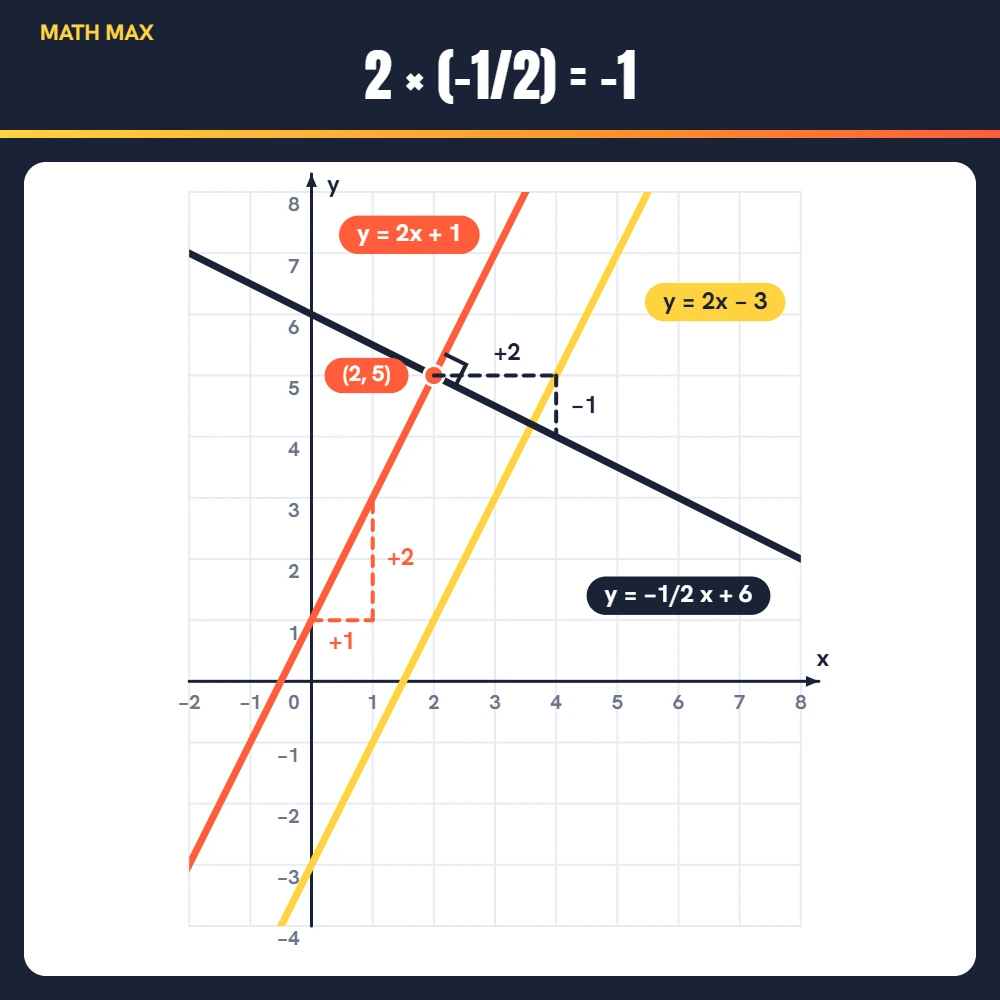
Take the three lines in the diagram below.
- y = 2x + 1 has slope 2.
- y = 2x − 3 also has slope 2, so it is parallel to the first line. It sits 4 units lower and never touches it.
- y = −1/2 x + 6 has slope −1/2. Because 2 × (−1/2) = −1, this line is perpendicular to y = 2x + 1.
The diagram shows the orange and gold lines running side by side. The navy line y = −1/2 x + 6 crosses the orange line at the point (2, 5), and the small square there marks the right angle.
Now compare y = 2x + 1 with y = −2x + 4. The product of the slopes is 2 × (−2) = −4, not −1, so these lines cross but are not perpendicular.
A common mistake is to change only the sign of the slope. The other common mistake is to flip the fraction and keep the sign, which gives 1/2. For a line perpendicular to the line y = 2x + 1, you need both steps, which gives −1/2.
If an equation is not in the form y = mx + b, solve it for y first. For example, 3x − 4y = 8 becomes y = 3/4 x − 2, so its slope is 3/4.
Why are the slopes negative reciprocals?
Look at the slope triangles in the diagram. On the orange line, a step of 1 across goes 2 up. Turn that little triangle a quarter turn, and the across part and the up part swap places, while one of them changes direction. The result is the navy triangle, which goes 2 across and 1 down, so its slope is −1/2.
The same thing happens with any slope. A line that goes a across and b up has slope b/a. A quarter turn gives b across and a down, so the new slope is −a/b. Multiply the two and you always get (b/a) × (−a/b) = −1.
This also gives you a quick way to graph perpendicular lines by hand. Draw the slope triangle of the first line, swap its two sides, and point one of them the opposite way.
How do you find the equation of a line perpendicular to a given line through a point?
Find the slope of the given line, then take its negative reciprocal. Put that new slope and the given point into point-slope form, y − y1 = m(x − x1), and simplify to y = mx + b. Finally, check your answer by plugging the point back in and by multiplying the two slopes to see that you get −1.
Example
Find the line perpendicular to y = 2x + 1 that passes through (2, 5).
- The slope of the given line is 2.
- The negative reciprocal of 2 is −1/2.
- Point-slope form gives y − 5 = −1/2 (x − 2).
- Multiply out the bracket to get y − 5 = −1/2 x + 1.
- Add 5 to both sides to get y = −1/2 x + 6.
That is the navy line in the diagram. As a check, x = 2 gives y = −1 + 6 = 5, so the line really goes through (2, 5).
Here is one with fractions. Find the line perpendicular to 3x − 4y = 8 through (3, −1). The given line is y = 3/4 x − 2, so the perpendicular slope is −4/3. Point-slope form gives y + 1 = −4/3 (x − 3), which simplifies to y = −4/3 x + 4 − 1, so y = −4/3 x + 3.
The check works because 3/4 × (−4/3) = −1, and x = 3 gives y = −4 + 3 = −1.
The free textbook Elementary Algebra from OpenStax uses these same steps for both parallel and perpendicular lines. Point-slope form is always the middle step, and only the slope changes.
How do you find the equation of a parallel line through a point?
A parallel line keeps the slope of the given line, so you skip the negative reciprocal and use the same slope in point-slope form. Every other step stays the same as for a perpendicular line.
For the line parallel to y = 2x + 1 through (2, 1), the slope stays 2. Then y − 1 = 2(x − 2), so y = 2x − 4 + 1, which gives y = 2x − 3. That is the gold line in the diagram.
A good way to get comfortable with slopes is to read a lot of them quickly. In the linear functions game every attack is a question about a line, so you get many slopes and equations in a short Math Max fight. Right angles and other shape facts come up in the geometry game as well. Both are free to play in the browser.

Are horizontal and vertical lines perpendicular?
Yes. A horizontal line and a vertical line always meet at a right angle. They are the one case where the rule m1 × m2 = −1 does not work, because a horizontal line has slope 0 and a vertical line has an undefined slope. Recognize this pair by its equations, such as y = 4 and x = 3.
Example
The lines y = 5 and x = 2 cross at the point (2, 5) at a right angle. To find the line perpendicular to y = 4 through (3, −2), notice that y = 4 is horizontal. The perpendicular line must be vertical and go through x = 3, so the answer is simply x = 3.
A common mistake is to say that the perpendicular slope of 0 is "−1/0". That fraction has no value, and that is exactly why the answer is a vertical line and not a line of the form y = mx + b. Parallel lines work as usual here. The lines y = 1 and y = −3 are parallel because both have slope 0.
The textbook Intermediate Algebra 2e from OpenStax states both rules side by side. Perpendicular slopes multiply to −1, and a vertical line and a horizontal line are always perpendicular.
What is a perpendicular bisector?
A perpendicular bisector is a line that cuts a line segment into two equal halves and crosses it at a right angle. To find its equation, find the midpoint and the slope of the segment, take the negative reciprocal of that slope, and use point-slope form with the midpoint. Every point on it is equally far from both ends.
Example
Find the perpendicular bisector of the segment from A(0, 0) to B(4, 2).
- The midpoint is ((0 + 4) ÷ 2, (0 + 2) ÷ 2) = (2, 1).
- The slope of AB is 2/4 = 1/2.
- The perpendicular slope is −2, because 1/2 × (−2) = −1.
- Point-slope form gives y − 1 = −2(x − 2), so y = −2x + 5.
Pick any point on this line, for example (0, 5). Its distance to A is 5, and its distance to B is the square root of 4² + 3², which is also 5. That equal distance is why perpendicular bisectors are used to find the center of a circle through three points.
Same slope means parallel, and a product of −1 means perpendicular
Everything in this topic comes back to two checks on the slopes. The one exception is a horizontal line with a vertical line, which are always perpendicular. To write a new line through a point, choose the right slope first, then let point-slope form do the rest, and always test the point at the end.
Train these next