
It's the quickest way to write the equation of a line when you know a single point and how steep the line is. Below you'll see how to use it, how to get it from two points, how to turn it into y = mx + b, and the sign slip that catches almost everyone.
How do you write an equation in point-slope form?
To write an equation in point-slope form, put the slope in place of m and the coordinates of one known point in place of x₁ and y₁ in y − y₁ = m(x − x₁). Leave x and y as letters, because they stand for every other point on the line. You don't need to simplify anything.
Example
Write the line through the point (2, 3) with slope 2.
- The point gives x₁ = 2 and y₁ = 3.
- The slope gives m = 2.
- Substitute: y − 3 = 2(x − 2).
That's the whole answer. To check it, take another point on the line. Moving 1 to the right from (2, 3) and 2 up lands on (3, 5). Put x = 3 and y = 5 into the equation: 5 − 3 = 2, and 2(3 − 2) = 2. Both sides match, so (3, 5) is on the line too.
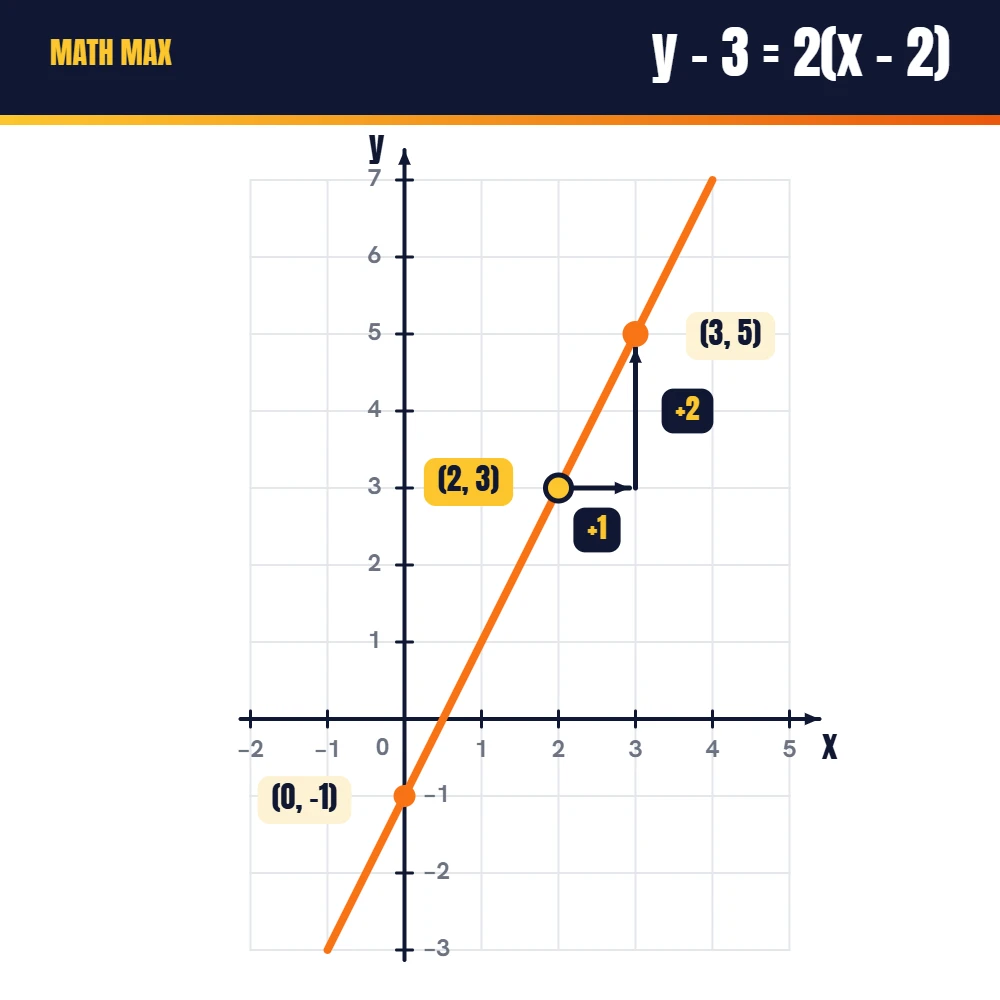
The graph also shows why the form is so handy. The point (2, 3) is written right there in the equation, so you can start drawing from it straight away.
How do you find point-slope form from two points?
To find point-slope form from two points, first work out the slope with m = (y₂ − y₁) ÷ (x₂ − x₁). Then pick either point and put it with the slope into y − y₁ = m(x − x₁). Both points give a correct equation, and after simplifying they turn into exactly the same line.
Example
Find the line through (1, −2) and (4, 7).
- Slope: m = (7 − (−2)) ÷ (4 − 1) = 9 ÷ 3 = 3
- With the point (1, −2): y − (−2) = 3(x − 1), which is y + 2 = 3(x − 1)
- With the point (4, 7): y − 7 = 3(x − 4)
The two equations look different, but expand them and both give y = 3x − 5. Many learners think they made a mistake when their answer doesn't match the answer key. If you used the other point, it's very likely the same line written from a different starting point.
Why does a negative point change the signs?
Point-slope form subtracts the coordinates of the point, so a negative coordinate turns into a plus sign. Subtracting −4 is the same as adding 4. This is the most common slip with point-slope form, and you can avoid it by writing the brackets out in full before you simplify.
Example
Write the line through (−4, −1) with slope 1/2.
- Substitute with brackets: y − (−1) = 1/2(x − (−4))
- Simplify the double signs: y + 1 = 1/2(x + 4)
Reading it backwards works too. In y + 5 = −2(x − 6), the point is (6, −5), not (6, 5). The sign inside the equation is always the opposite of the sign of the coordinate.
How do you convert point-slope form to slope-intercept form?
To convert point-slope form to slope-intercept form, multiply out the bracket on the right, then move the number on the left to the other side so y is on its own. The result is y = mx + b. The slope stays the same, and the number you end up with on its own is the y-intercept.
Example
Convert y − 3 = 2(x − 2).
- Multiply out the bracket: y − 3 = 2x − 4
- Add 3 to both sides: y = 2x − 1
The slope is still 2, and the line crosses the y-axis at (0, −1), exactly as the graph above shows. The reverse works too. For y = −3x + 5, choose any x, say x = 1, which gives y = 2. The point (1, 2) and the slope −3 give y − 2 = −3(x − 1).
Which form should you use?
Each form is good at a different job.
- Point-slope form is fastest to write when you know a point and the slope, or two points.
- Slope-intercept form is easiest to read and graph, because the slope and the y-intercept are right there.
- Standard form, Ax + By = C, is handy for finding where the line crosses both axes.
They all describe the same line, so you can start in point-slope form and convert at the end if your teacher wants y = mx + b.
Where does the point-slope formula come from?
The point-slope formula comes straight from the slope formula. Take a fixed point (x₁, y₁) and any other point (x, y) on the line. The slope between them is m = (y − y₁) ÷ (x − x₁). Multiply both sides by (x − x₁) and you get y − y₁ = m(x − x₁), which is point-slope form.
Example
On the line through (2, 3) with slope 2, take the point (5, 9). The slope between the two points is (9 − 3) ÷ (5 − 2) = 6 ÷ 3 = 2. That matches the slope of the line, so (5, 9) is on it. Point-slope form says the same thing in one line, because 9 − 3 = 2(5 − 2).
The open textbook OpenStax Elementary Algebra 2e builds the formula the same way and then uses it to find the equation of a line from a point, from two points, and from parallel and perpendicular lines. Seeing where it comes from also makes it easier to remember, because you only need the slope formula.
How do you use point-slope form for parallel and perpendicular lines?
For a parallel line, use the same slope as the original line with your new point. For a perpendicular line, use the negative reciprocal of the slope: flip the fraction and change the sign. Then substitute the slope and the point into y − y₁ = m(x − x₁), just as before.
Example
Find the line through (2, 3) that is perpendicular to y = 2x − 1.
- The original slope is 2, which is 2/1.
- Flip it and change the sign: −1/2.
- Point-slope form: y − 3 = −1/2(x − 2)
- Simplified: y = −1/2x + 4
Check with the point: −1/2 × 2 + 4 = −1 + 4 = 3. It works. The parallel line through (6, 0) would be y − 0 = 2(x − 6), which simplifies to y = 2x − 12.
Can every line be written in point-slope form?
Every line can be written in point-slope form except a vertical line. A vertical line has the same x for every point, so the run is 0 and the slope would mean dividing by zero. A vertical line through (3, 1) is written simply as x = 3. Horizontal lines are fine, because their slope is 0.
Example
The horizontal line through (1, 4) has slope 0. In point-slope form that's y − 4 = 0(x − 1). The right side is always 0, so the equation simplifies to y = 4.
Practising point-slope form until it feels automatic
Writing and converting lines gets quicker the more lines you see. In the linear functions game, every attack is a question about a line, so spotting slopes, points and intercepts becomes automatic during a fight instead of on a homework sheet. A few short rounds at a time keep the steps fresh.

Converting to slope-intercept form is mostly a small equation to solve. If moving terms from one side to the other slows you down, a few rounds of the equations game make that step much faster. The same skill comes back every time you rearrange a formula.
The letters can change from country to country. Some schools write the slope as k or a instead of m, but the idea stays the same. The number in front of the bracket is the slope, and the numbers inside the brackets come from a point on the line.
One point and a slope are all a line needs
A single point and a slope pin down a straight line completely, and point-slope form writes that fact down directly. Substitute carefully, keep the brackets until the signs are sorted, and check your equation with a second point. From there, converting to y = mx + b takes two short steps.
Train these next