
How do you read Roman numerals?
Read Roman numerals from left to right. When a symbol is equal to or larger than the one after it, add its value. When a smaller symbol comes directly before a larger one, subtract it. So VI is 5 + 1 = 6, while IV is 5 − 1 = 4. For long numerals, split them into small chunks first.
Example
Take MCMXCIV. Split it into chunks wherever a smaller symbol comes before a larger one.
- M = 1,000
- CM = 1,000 − 100 = 900
- XC = 100 − 10 = 90
- IV = 5 − 1 = 4
- Add the chunks. 1,000 + 900 + 90 + 4 = 1,994
So MCMXCIV is 1,994. The chunking step matters, because reading the letters one by one and adding them all would give a much larger and wrong number.
Shorter numerals that run from the largest value to the smallest are simply added. XVI is X (10) + V (5) + I (1) = 16, and LX is L (50) + X (10) = 60.
Which subtraction pairs are allowed?
Only six subtraction pairs exist in the standard system. These are IV (4), IX (9), XL (40), XC (90), CD (400) and CM (900). Only I, X and C are ever subtracted, and each one only from the next two larger symbols. That is why 99 is XCIX (90 + 9) and not IC, and 49 is XLIX (40 + 9) and not IL.
Where do the symbols come from?
A helpful way to remember the first symbols is to think of fingers. According to Live Science, one explanation is that I stood for one finger, V for the shape made by the thumb and forefinger of an open hand, and X for two hands. The pattern then repeats in steps of 1, 5 and 10, up to M for 1,000.
Do Roman numerals have to be capital letters?
No. Capitals are the standard form, but lowercase numerals (i, ii, iii, iv) are common for page numbers at the start of a book and for items in a list. Old handwritten documents often end a numeral with a j instead of an i. The National Archives guide to Roman numerals shows forms like viij for 8.
How do you write a number in Roman numerals?
Break the number into thousands, hundreds, tens and ones, and write each part separately, starting with the largest. Then place the pieces side by side. For 349, that means 300 + 40 + 9, which gives CCC + XL + IX = CCCXLIX. A symbol is never repeated more than three times in a row in standard form.
Example
Write 2,026 in Roman numerals. Split it into 2,000 + 20 + 6. In Roman numerals, 2,000 is MM, 20 is XX and 6 is VI. Put them together and you get MMXXVI.
Splitting a number into thousands, hundreds, tens and ones is the same skill children use for place value in ordinary numbers. Roman numerals just write each of those parts with letters instead of a single digit.
One pattern for ones, tens and hundreds
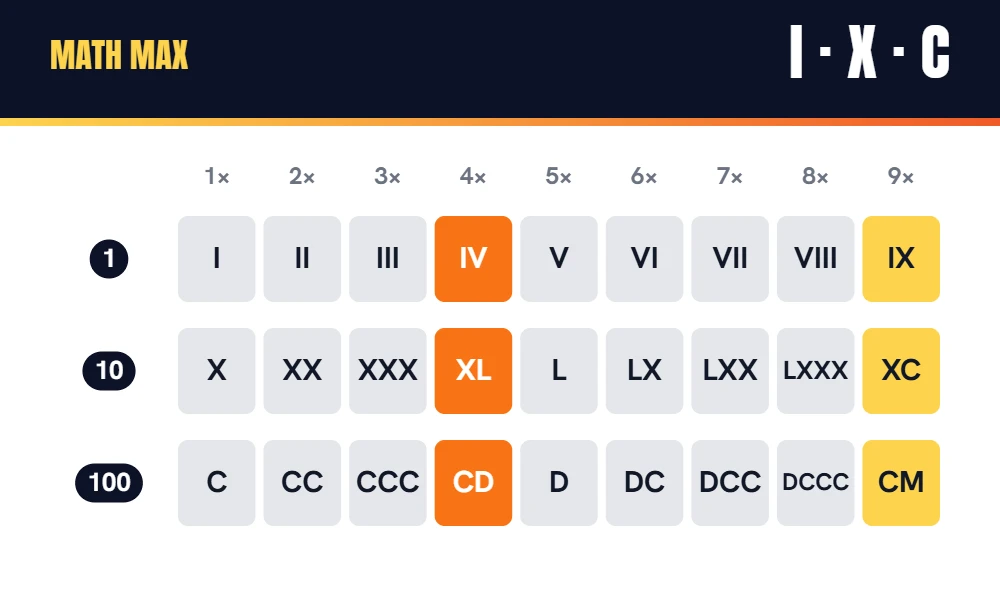
The most useful trick is that ones, tens and hundreds all follow the same pattern. Only the letters change. Once a child knows the pattern for 1 to 9, they can write any number up to 999.
- Ones (1 to 9): I, II, III, IV, V, VI, VII, VIII, IX
- Tens (10 to 90): X, XX, XXX, XL, L, LX, LXX, LXXX, XC
- Hundreds (100 to 900): C, CC, CCC, CD, D, DC, DCC, DCCC, CM
Compare the rows and you will see that the shape is identical. IV, XL and CD sit in the same spot, and so do IX, XC and CM.
Common mistakes
A common mistake is to take a shortcut by subtracting across large gaps, for example writing 1,999 as MIM. The correct form is MCMXCIX, built from 1,000 + 900 + 90 + 9. Another frequent slip is writing 10 as VV. Since V, L and D are never repeated, 10 must be X. Many kids also forget to split a numeral into chunks before reading it, which makes long numerals feel harder than they are.
Why do Roman numerals have no zero?
Roman numerals have no zero because the system does not use place value. In the number 305, the zero holds the empty tens place, so the 3 and the 5 land in the right positions. In Roman numerals, 305 is simply CCCV. Every letter carries its own value wherever it stands, so nothing ever needs to hold an empty place.
Example
Compare 25, 205 and 2,005. In ordinary digits, zeros push the 2 and the 5 into different places. In Roman numerals the three numbers are XXV, CCV and MMV. The letters themselves tell you the size, so there are no gaps to fill.
The lack of place value is also why written calculation with Roman numerals is slow. Lining up columns to add or multiply only works when every position has a fixed meaning. Live Science notes that Roman numerals eventually gave way to the more flexible Hindu-Arabic numerals that we use today.
What is the largest Roman numeral?
In standard form, the largest number is 3,999, written MMMCMXCIX, because M can only be repeated three times. For larger numbers, a bar placed over a numeral multiplies its value by 1,000, as Britannica explains. With a bar, V means 5,000 and X means 10,000.
Why do clocks show IIII instead of IV?
Many clock faces show 4 as IIII instead of IV, and Britannica notes that clocks usually display 4 this way. Both forms have a long history, and old documents write 4 as IIII, iiij or IV. On a clock, IIII is a design tradition rather than a mistake. In schoolwork, dates and most other places, IV is the standard form.
Example
Look at a clock with Roman numerals and read the hours from 1 to 12. You will probably see I, II, III, IIII, V, VI, VII, VIII, IX, X, XI and XII. On the same clock, 9 is usually still written IX. So a clock can follow its own tradition for 4 and the usual subtraction rule for 9.
When a child spots IIII on a clock and IV in a book, it is a good chance to explain that writing systems change over time. The rules taught today are a later standard of a much older and looser habit.
Where are Roman numerals used today?
Roman numerals still appear on clock faces, in the names of kings, queens and popes, in film and game sequels, in chapter and section numbers, and in the copyright year at the end of films. In many languages, including French, Spanish, Italian, Polish and Russian, centuries are usually written in Roman numerals as well.
Example
Louis XIV of France is Louis the 14th. Pope John XXIII is John the 23rd. A history book in many countries writes the 19th century as the XIX century, and the 21st century as the XXI century. Reading these quickly is mostly a matter of spotting the chunks, such as XIX = X + IX = 10 + 9.
Live Science lists further uses, such as numbering moons in astronomy, groups in chemistry and chords in music theory. Lowercase numerals also appear in outlines and tables of contents.

The fastest way to get comfortable is to read many numerals in short bursts. In the Roman numerals game, every attack in a fight is a numeral to convert, so reading them at a glance becomes part of winning a round. A few short rounds a week help the chunks become automatic.
Seven symbols and one pattern are all you need
Every Roman numeral comes from seven letters, an add rule, a subtract rule and one repeating pattern. Use this chart to check your answers, but try to build each number from its parts before you look.
- 1 to 10: I, II, III, IV, V, VI, VII, VIII, IX, X
- 11 to 20: XI, XII, XIII, XIV, XV, XVI, XVII, XVIII, XIX, XX
- 10 to 100 in tens: X, XX, XXX, XL, L, LX, LXX, LXXX, XC, C
- 100 to 1,000 in hundreds: C, CC, CCC, CD, D, DC, DCC, DCCC, CM, M
- 1,000, 2,000 and 3,000: M, MM, MMM
If a numeral looks long, split it at every point where a smaller letter comes before a larger one. Each chunk is easy on its own, and adding the chunks gives you the number.
Train these next