
Sine, cosine and tangent in a right triangle
Each of these ratios compares two sides of a right triangle, seen from one of its sharp angles. In SOHCAHTOA trigonometry, the letters are only a way to remember which two sides go together. What matters is the idea behind them, because once you can name the sides from the angle, every trig ratio problem follows the same few steps.
How do you label the opposite, adjacent and hypotenuse?
Start from the angle you are working with, usually called θ. The hypotenuse is the longest side, across from the right angle. The opposite side is the one across from θ and does not touch it. The adjacent side touches θ and is not the hypotenuse. The labels change if you switch to the other angle.
The diagram shows a right triangle with sides 3, 4 and 5. The angle θ sits where the side of length 4 meets the side of length 5. The side of length 5 faces the right angle, so it is the hypotenuse. The side of length 3 is across from θ, so it is the opposite side. The side of length 4 runs along θ, so it is the adjacent side.
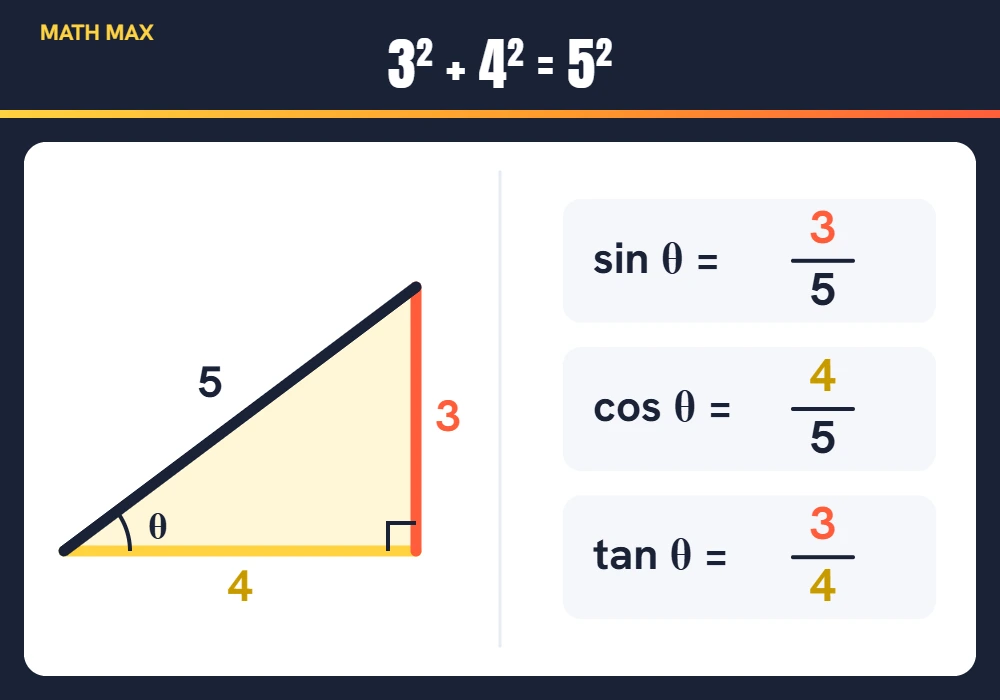
Now look from the other sharp angle, where the side of length 3 meets the side of length 5, to see why the angle comes first. From there, the side of length 4 is across from the angle, so it becomes the opposite side, and the side of length 3 becomes the adjacent side. The hypotenuse never changes.
What are the SOH CAH TOA rules?
The SOH CAH TOA rules are three formulas for a right triangle and one chosen angle θ. Sine θ equals opposite divided by hypotenuse. Cosine θ equals adjacent divided by hypotenuse. Tangent θ equals opposite divided by adjacent. Each letter group names the ratio first, then the top side, then the bottom side of the fraction.
Written as formulas, the SOH CAH TOA formula looks like this:
- sin θ = opposite / hypotenuse
- cos θ = adjacent / hypotenuse
- tan θ = opposite / adjacent
For the triangle in the diagram, sin θ = 3/5 = 0.6, cos θ = 4/5 = 0.8 and tan θ = 3/4 = 0.75.
The size of the triangle does not matter. A triangle with sides 6, 8 and 10 has the same angles, so sin θ is still 6/10 = 0.6. The OpenStax precalculus chapter on right triangle trigonometry uses the same three definitions. A ratio depends only on the angle, and that is what makes sine, cosine and tangent useful.
Which trig ratio should you choose?
Choose the ratio that uses the two sides in your problem. One side is the side you know, and the other is the side you want to find. Opposite and hypotenuse means sine. Adjacent and hypotenuse means cosine. Opposite and adjacent means tangent. The third side plays no part, so you can ignore it.
A quick way to decide:
- Mark the angle you know or want to find.
- Label the three sides as opposite, adjacent and hypotenuse from that angle.
- Cross out the side that is neither given nor asked for.
- Pick the ratio whose two sides are left.
If you know the hypotenuse and want the side across from the angle, sine is the ratio to use.
How do you find a missing side with SOHCAHTOA?
To find a missing side with SOHCAHTOA, pick the ratio that links the known side and the unknown side to the known angle. Write it as an equation and solve it. If the unknown side is on top of the fraction, multiply. If the unknown side is on the bottom, divide the known side by the sine, cosine or tangent value.
The two SOHCAHTOA examples below show both cases.
Example
A ladder 5 m long leans against a wall and makes an angle of 70° with the ground. How high up the wall does it reach? The ladder is the hypotenuse, and the height is the side opposite the 70° angle. Opposite and hypotenuse means sine.
- sin 70° = height / 5
- height = 5 × sin 70°
- height ≈ 5 × 0.940 ≈ 4.70 m
Example with the unknown on the bottom
In a right triangle, an angle is 25° and the adjacent side is 8 cm. You want the hypotenuse. Adjacent and hypotenuse means cosine, so cos 25° = 8 / hypotenuse. Rearranged, the hypotenuse is 8 ÷ cos 25° ≈ 8 ÷ 0.906 ≈ 8.83 cm. The hypotenuse is longer than 8, as it should be.
How do you find a missing angle with inverse trig functions?
To find a missing angle, work out the ratio of the two known sides, then use the inverse function on a calculator. These are written sin⁻¹, cos⁻¹ and tan⁻¹ and are also called arcsin, arccos and arctan. They take a ratio and give back the angle. Set the calculator to degree mode before you start.
Example
In the diagram, the opposite side is 3 and the adjacent side is 4. Opposite and adjacent means tangent, so tan θ = 3/4 = 0.75. Then θ = tan⁻¹(0.75) ≈ 36.87°. You can check with the other ratios, because sin⁻¹(3/5) and cos⁻¹(4/5) also give about 36.87°. The other sharp angle is 90° − 36.87° = 53.13°, since the three angles of a triangle add up to 180°.
The minus one in sin⁻¹ does not mean 1 divided by sine. It means "the angle whose sine is this value". Once labeling, choosing a ratio and using inverse functions feel natural, the trigonometry game turns them into quick rounds of a Math Max fight. Spotting the right ratio fast helps there.

How do you memorize SOH CAH TOA?
The quickest way to memorize SOH CAH TOA is to say the word out loud a few times while pointing at the sides of a drawn triangle. The memory aid sticks better when it is tied to meaning. The hypotenuse appears in sine and cosine but never in tangent, and tangent always uses the two shorter sides.
Two patterns help even without the letters. First, sine and cosine always divide by the hypotenuse, which is the longest side, so their values are never larger than 1. Second, tangent equals sine divided by cosine. With the diagram, (3/5) ÷ (4/5) = 3/4, which is tan θ.
What are the most common SOHCAHTOA mistakes?
Most SOHCAHTOA mistakes come from labeling, not from the formulas. Learners name the opposite and adjacent sides from the wrong angle, take the longest leg for the hypotenuse, or leave the calculator in radian mode. Checking the angle, the right-angle box and the calculator setting before each problem prevents almost all of them.
- Wrong reference angle. Opposite and adjacent depend on which angle you use. Mark θ before labeling anything.
- Hypotenuse confusion. The hypotenuse is always across from the right angle. It is never part of tangent.
- Radian mode. In degree mode, sin 30° = 0.5. In radian mode, the same keys give about −0.988, because the calculator reads 30 as 30 radians. An answer that looks strange is often a mode problem.
- Using SOHCAHTOA on a triangle without a right angle. These ratios only work in right triangles.
- Rounding too early. Keep the full calculator value until the last step.
What are the basic trigonometric formulas?
The basic trigonometric formulas start with the three trig ratios, sine, cosine and tangent. Two more follow directly from them. Tangent equals sine divided by cosine, and the square of sine plus the square of cosine always equals 1. That second identity comes from the Pythagorean theorem applied to the same triangle.
Using the diagram, sin²θ + cos²θ = (3/5)² + (4/5)² = 9/25 + 16/25 = 25/25 = 1. This is the same fact as 3² + 4² = 5², divided through by 25. The Pythagorean theorem and SOHCAHTOA often work together. Use one to find a third side, and the other to find an angle.
What is the 30-60-90 rule for triangles?
The 30-60-90 rule says that in a right triangle with angles of 30°, 60° and 90°, the sides are always in the ratio 1 : √3 : 2. The shortest side is across from 30°, the hypotenuse is twice as long, and the remaining side is the shortest side times √3, about 1.732.
This gives exact trig values without a calculator. For the 30° angle, sin 30° = 1/2 and cos 30° = √3/2. For example, if the shortest side is 6, the hypotenuse is 12 and the middle side is 6√3 ≈ 10.39. Special triangles like this also come up in the geometry game. Knowing the side pattern saves time there.
What about angles larger than 90 degrees?
SOHCAHTOA works for the two sharp angles of a right triangle, which are always less than 90°. For larger angles, sine, cosine and tangent are defined with a circle of radius 1 instead of a triangle. The ratios keep their meaning, but the values can become negative.
The unit circle shows how this works and why, for example, cos 120° = −0.5. It extends the same ideas to any angle.
Label the sides first and the right ratio follows
SOHCAHTOA is a short reminder of a simple idea. Each trig ratio compares two sides as seen from one angle. Mark the angle, name the sides, pick the ratio that uses the two sides you care about, and check that the calculator is in degree mode. Then a missing side or angle takes only a few steps.
Train these next