
How do you calculate the volume of a cylinder?
To calculate the volume of a cylinder, square the radius of the circular base, multiply by π, which is about 3.14, and then multiply by the height. That is the formula V = πr²h. Write the answer in cubic units, such as cm³ or m³, because volume measures the space inside a solid rather than a length or a surface.
Example
Find the volume of a cylinder with a radius of 3 cm and a height of 10 cm.
- Square the radius. 3 × 3 = 9
- Multiply by π to get the area of the base. 9 × π ≈ 28.27 cm²
- Multiply by the height. 9π × 10 = 90π
- Add cubic units. The volume is about 282.74 cm³
You can also leave the answer as 90π cm³. This exact form avoids rounding and is common in later school years.
The most common slip is multiplying the radius by 2 instead of squaring it. For a radius of 3 cm, 3 × 2 = 6, but 3² = 9. Another is squaring the height as well. Only the radius is squared, because only the base is a circle.
Why is the volume of a cylinder πr²h?
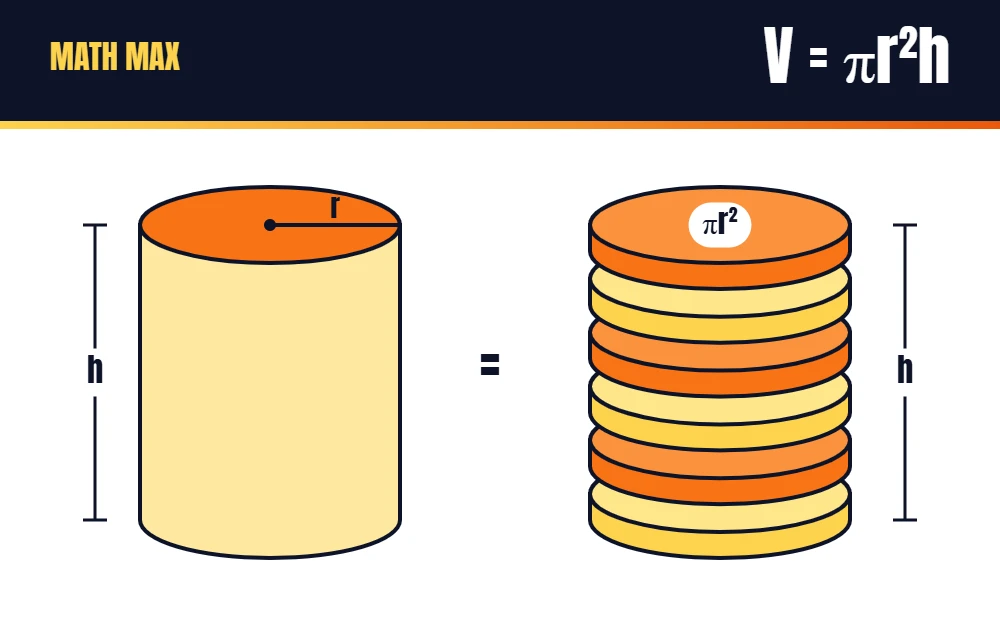
A cylinder is a stack of identical circles, like a pile of coins. Each circle has an area of πr², and the stack is h units tall. So the volume is the area of the base multiplied by the height. Prisms follow the same rule, V = base area × height.
Example
Picture a stack of thin round crackers, each with an area of 20 cm². If the stack is 5 cm tall, it fills 20 × 5 = 100 cm³ of space. A cylinder with a base area of 20 cm² and a height of 5 cm has the same volume.
This picture also explains what happens when the cylinder changes shape. Double the height, and you double the number of layers, so the volume doubles. Double the radius, and each layer becomes four times as big, because the radius is squared. So the volume becomes four times as large.
A cylinder also sits neatly beside two other round solids. A cone with the same base and height holds exactly one third of the cylinder. A ball that fits snugly inside a cylinder holds two thirds of it, a result that Britannica says Archimedes was so proud of that he asked for it to be marked on his tomb.
How do you find the volume of a cylinder from the diameter?
To find the volume from the diameter, halve the diameter to get the radius, then use V = πr²h. The diameter is the distance straight across the circular base through its centre, so it is twice the radius. In one step, the formula is V = πd²h ÷ 4, which gives exactly the same answer.
Example
A tin has a diameter of 8 cm and a height of 12 cm. Halve the diameter to get a radius of 4 cm. Then 4² × π × 12 = 192π ≈ 603.19 cm³.
With the one-step formula, 8² = 64, then 64 × π × 12 ÷ 4 = 192π ≈ 603.19 cm³. Both routes agree.
Putting the diameter straight into πr²h is a very common mistake. With the tin above, that gives 64 × π × 12 ≈ 2,412.74 cm³, which is four times too big. If an answer looks surprisingly large, check that you halved the diameter first.
How do you convert the volume of a cylinder to litres?
To convert the volume of a cylinder to litres, work out the volume in cubic centimetres and divide by 1,000, because 1 litre is 1,000 cm³. If the volume is in cubic metres, multiply by 1,000 instead, because 1 m³ holds 1,000 litres. Make sure every measurement uses the same unit before you start.
Example
A drinking glass has a diameter of 7 cm and a height of 10 cm, measured on the inside.
- Find the radius. 7 ÷ 2 = 3.5 cm
- Find the volume. 3.5² × π × 10 ≈ 384.85 cm³
- Convert to litres. 384.85 ÷ 1,000 ≈ 0.38 litres, or about 385 ml
For a bigger example, take a water tank with a radius of 0.5 m and a height of 1.2 m. Its volume is 0.5² × π × 1.2 ≈ 0.94 m³. Multiply by 1,000, and the tank holds about 942 litres.
A frequent problem is mixed units, such as a radius in centimetres and a height in metres. Convert everything to one unit first. Moving between cm³, m³, millilitres and litres becomes much quicker with a few rounds of unit conversion.
How do you find the height or radius of a cylinder from its volume?
To find the height, divide the volume by the area of the base, so h = V ÷ (πr²). To find the radius, divide the volume by π times the height, then take the square root, so r = √(V ÷ (πh)). Both formulas are simply V = πr²h worked backwards, one step at a time.
Example
A cylindrical jug must hold 1 litre, which is 1,000 cm³, and its radius is 5 cm. Its height must be 1,000 ÷ (π × 5²) = 1,000 ÷ 78.54 ≈ 12.73 cm.
Now the other way round. A cylinder with a height of 10 cm holds 500 cm³. Its radius is √(500 ÷ (π × 10)) = √15.92 ≈ 3.99 cm.
To check either answer, put the numbers back into V = πr²h. For the jug, π × 5² × 12.73 ≈ 1,000 cm³, so the height is right.

The formula sticks best when you use it often, with different numbers. In the geometry game, each attack in a fight is a shape question, so recalling πr²h quickly becomes part of winning a round. In the game π counts as 3, so every answer is a whole number you can work out in your head. Short, frequent rounds work better than one long session.
How do you find the volume of a hollow cylinder?
A hollow cylinder, such as a pipe, is a big cylinder with a smaller one removed from the middle. Find the volume of the outer cylinder, subtract the volume of the hole, and what remains is the material. As a formula, that is V = π(R² − r²)h, where R is the outer radius and r is the inner radius.
Example
A pipe is 100 cm long, with an outer radius of 5 cm and an inner radius of 4 cm.
- Square both radii. 5² = 25 and 4² = 16
- Subtract. 25 − 16 = 9
- Multiply by π and the length. 9 × π × 100 = 900π ≈ 2,827.43 cm³
A common mistake is subtracting the radii before squaring them. That gives (5 − 4)² × π × 100 = 100π ≈ 314.16 cm³, which is far too small. Square each radius first, then subtract.
Find the base area first, then multiply by the height
Every cylinder volume question comes down to the same two steps. Find the area of the circular base, then multiply by the height. Use this list to choose the right starting point.
- Given the radius r and height h: V = πr²h
- Given the diameter d: r = d ÷ 2, or V = πd²h ÷ 4
- To find the height: h = V ÷ (πr²)
- To find the radius: r = √(V ÷ (πh))
- Hollow cylinder: V = π(R² − r²)h
- Litres: cm³ ÷ 1,000, or m³ × 1,000
Write the answer in cubic units, and convert to litres only at the end, once the volume is correct.