Mathematicians write it with the Greek letter φ (phi), and it has a reputation for hiding in sunflowers, famous buildings and beautiful faces. Some of that reputation is earned and a lot of it isn't. Here's the math first, then the honest version of where it really shows up.
How do you calculate the golden ratio?
The golden ratio is calculated with the formula φ = (1 + √5) ÷ 2. The square root of 5 is about 2.236, so you add 1, divide by 2 and get about 1.618. The decimals never end and never repeat, because φ is an irrational number. For most everyday uses, 1.618 is close enough.
Example
Work it out with a calculator in three steps.
- √5 ≈ 2.236
- 1 + 2.236 = 3.236
- 3.236 ÷ 2 = 1.618
So φ ≈ 1.618. If you need more precision, φ = 1.6180339887 to ten decimal places.
Where does (1 + √5) ÷ 2 come from?
Take a line and split it into a long part a and a short part b. The split is golden when the whole line compares to the long part in the same way the long part compares to the short part. In symbols, (a + b) ÷ a = a ÷ b. That shared value is φ.
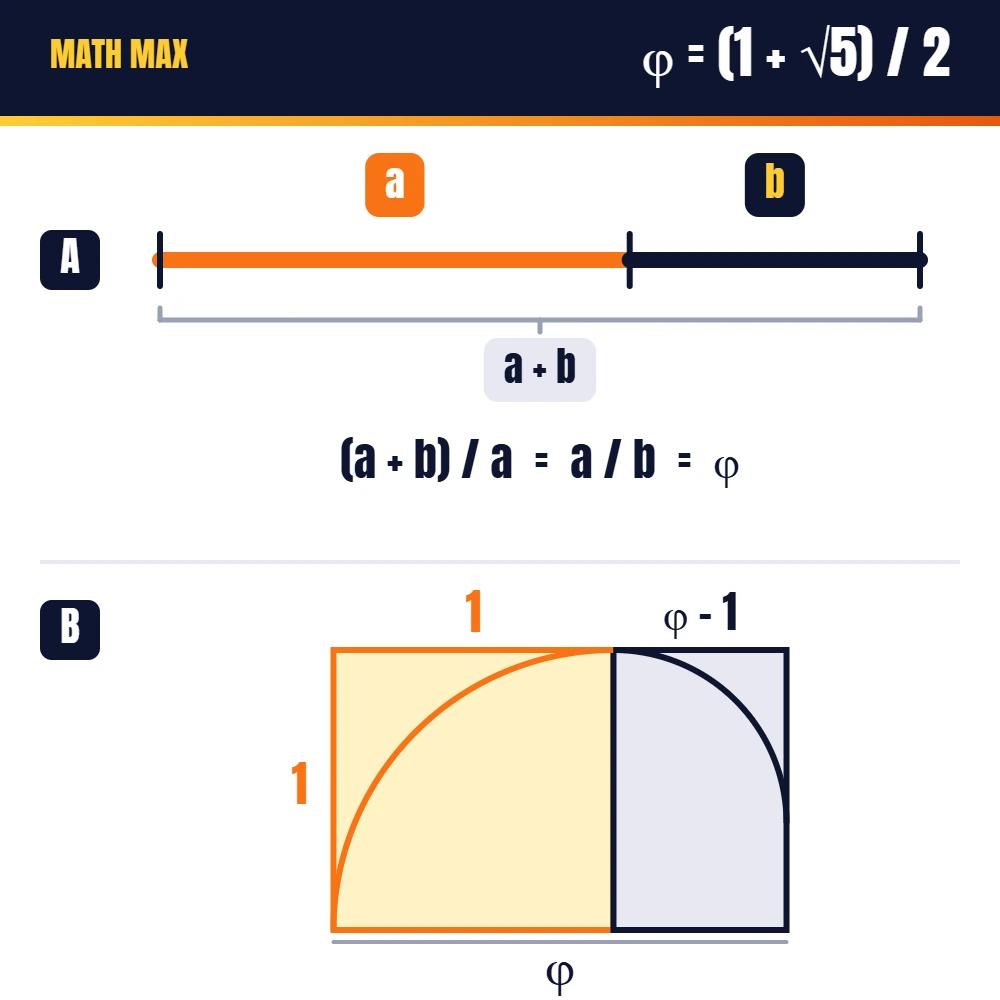
Now make the short part 1, so the long part is φ. The rule becomes (φ + 1) ÷ φ = φ. Multiply both sides by φ and you get φ² = φ + 1, or φ² − φ − 1 = 0. That is a quadratic equation, and its positive solution is (1 + √5) ÷ 2. Britannica describes the same rearrangement into x² − x − 1 = 0.
Why do 1.618, 0.618 and 2.618 look so alike?
Because φ² = φ + 1, squaring φ just adds 1. So φ² ≈ 2.618. Divide the same equation by φ and you get φ = 1 + 1 ÷ φ, which means 1 ÷ φ = φ − 1 ≈ 0.618. That's why three different numbers share the same decimals.
Why is the golden ratio so special?
The golden ratio is special because it is the only positive number whose square is the number plus one, and whose reciprocal is the number minus one. It also connects geometry and counting. The same value appears when you split a line in a balanced way, when you draw a regular pentagon and when you divide neighbouring Fibonacci numbers.
Example
In a regular pentagon with sides of 1, every diagonal (the line from one corner to a non-neighbouring corner) is exactly φ long, about 1.618. That's why the five-pointed star drawn inside a pentagon is full of golden ratios. Each point of the star is cut by the other lines in golden proportion.
The idea is very old. Britannica traces it back to Euclid, who called it the "extreme and mean ratio" in his Elements.
Is the golden ratio the same as pi?
No. Pi (π ≈ 3.14) is the ratio of a circle's circumference to its diameter, while the golden ratio (φ ≈ 1.618) comes from splitting a line. Both are irrational numbers with endless decimals, which is probably why people mix them up. They have different values and come from different shapes.
Are the golden ratio and the Fibonacci sequence the same?
The golden ratio and the Fibonacci sequence are not the same thing, but they are closely linked. The Fibonacci sequence is a list of whole numbers where each number is the sum of the two before it. If you divide each Fibonacci number by the one before it, the answers get closer and closer to the golden ratio.
Example
Take neighbouring numbers from the Fibonacci sequence and divide.
- 5 ÷ 3 ≈ 1.667
- 8 ÷ 5 = 1.6
- 13 ÷ 8 = 1.625
- 21 ÷ 13 ≈ 1.615
- 34 ÷ 21 ≈ 1.619
- 89 ÷ 55 ≈ 1.618
The answers jump above and below 1.618 and settle down quickly. By 144 ÷ 89 the result already matches φ to three decimal places. This is a nice calculator activity for children, because they can watch a pattern appear out of plain division.
Finding the rule behind a list of numbers is a skill that goes far beyond Fibonacci. In the number sequences game, every attack is a sequence with a missing number, and you have to spot the rule before your opponent does.

How do you draw a golden rectangle?
A golden rectangle has a long side that is about 1.618 times its short side. To draw one, multiply the short side by 1.618, or divide the long side by 1.618 to find the short side. You can also build one exactly with a compass, starting from a square, without measuring any decimals.
Example
If the short side is 10 cm, the long side is 10 × 1.618 ≈ 16.2 cm. If a page is 1000 pixels wide and you want a golden split, divide by φ. You get a main column of about 618 pixels and a side column of about 382 pixels.
To draw it with a compass, follow these steps.
- Draw a square with sides of 1 (for example 1 decimetre).
- Mark the midpoint of the bottom side.
- Put the compass point on that midpoint and open it to reach the top corner on the far side. That distance is √5 ÷ 2, about 1.118.
- Swing the compass down to the extended bottom line. The new length is 0.5 + 1.118 = 1.618.
- Complete the rectangle. Its sides are 1 and φ.
If you cut the square off a golden rectangle, the piece that's left is another golden rectangle. Repeat that and draw a quarter circle in each square, and you get the spiral that often appears in pictures of the golden ratio. Geometry like this is also part of the geometry game, where shapes, angles and areas turn into quick challenges.
Where does the golden ratio show up in nature?
The clearest example in nature is the way many plants arrange their leaves and seeds. Each new seed in a sunflower head grows at roughly the same turn from the last one, about 137.5°. This golden angle packs the seeds tightly with no gaps, and it produces spirals whose counts are often Fibonacci numbers.
Example
The golden angle comes straight from φ. Divide a full turn by φ² and you get 360° ÷ 2.618 ≈ 137.5°. Another way to see it is that the turn splits the circle into two arcs, about 222.5° and 137.5°, in golden proportion.
A 2022 review by researchers at the University of Nottingham, The Golden Ratio in Nature, collects examples at many different scales and describes the ratio's "tendency to appear in many different scientific and artistic fields". A tendency is the right word. Plenty of plants follow other patterns, so it isn't a law of nature.
Is the nautilus shell a golden spiral?
Usually not. The nautilus grows in a logarithmic spiral, which keeps its shape as it gets bigger, and that is beautiful in its own right. Measurements of real shells tend to give a growth ratio different from φ. A golden spiral drawn on top of a nautilus photo is a nice picture, not a measurement.
Is the golden ratio really in art, buildings and faces?
Mostly no. Claims that the Parthenon, famous paintings or attractive faces follow the golden ratio don't hold up when people measure carefully. In a 2022 article in The Conversation, UNSW mathematician Thomas Britz explains that φ is very rarely found in ancient Greek art and architecture.
Example
The popular claim about the Parthenon is that its front fits a golden rectangle. Britz writes that careful calculations show this claim is false. The same goes for "golden ratio face tests" that score celebrities. The face mask they are based on has been debunked, and there is no single number that decides whether a face is beautiful.
A common reason the myth survives is cherry-picking. Almost any building or face has some pair of lengths whose ratio is close to 1.6, especially if you get to choose where to measure. Ratios like 3 ÷ 2 = 1.5 or 16 ÷ 9 ≈ 1.78 are also pleasant and much more common in screens and photos. A fair test checks many objects and counts the misses as well as the hits.
Do artists and designers use the golden ratio on purpose?
Some do. Designers sometimes use 1.618 as a starting point for layouts, picture frames or font sizes, because it gives a split that is neither too even nor too lopsided. That is a design choice, not proof that the ratio is hidden in everything beautiful. It works the same way as any other tidy proportion.
The golden ratio is real math, not a beauty rule
The golden ratio is a precise number, (1 + √5) ÷ 2 ≈ 1.618, with properties that make mathematicians smile. Squaring it adds 1, dividing 1 by it takes 1 away, and Fibonacci numbers home in on it. It shapes the seed spirals of many plants, while most stories about faces and famous buildings are wishful measuring.
A good way to explore it with a child is to keep it hands-on. Divide Fibonacci numbers on a calculator, draw a golden rectangle with a compass, or count the spirals on a pine cone. Each one shows a real pattern, and none of them needs any myth to be interesting.