The same rule works for small and large numbers, for negative numbers and for decimals. Below you'll find visual tricks that help children remember it, how to read the signs out loud, and the comparisons that trip learners up most often.
How do you remember which sign is greater than?
To remember which sign is greater than, look at the open side. The wide, open side of > or < always faces the bigger number, and the narrow point always faces the smaller one. So 9 > 4 means 9 is greater than 4, and 4 < 9 means 4 is less than 9.
Example
Compare 7 and 3.
- 7 is the bigger number, so the open side faces 7.
- With 7 on the left, write 7 > 3. The sign opens towards 7.
- With 3 on the left, write 3 < 7. The sign still opens towards 7.
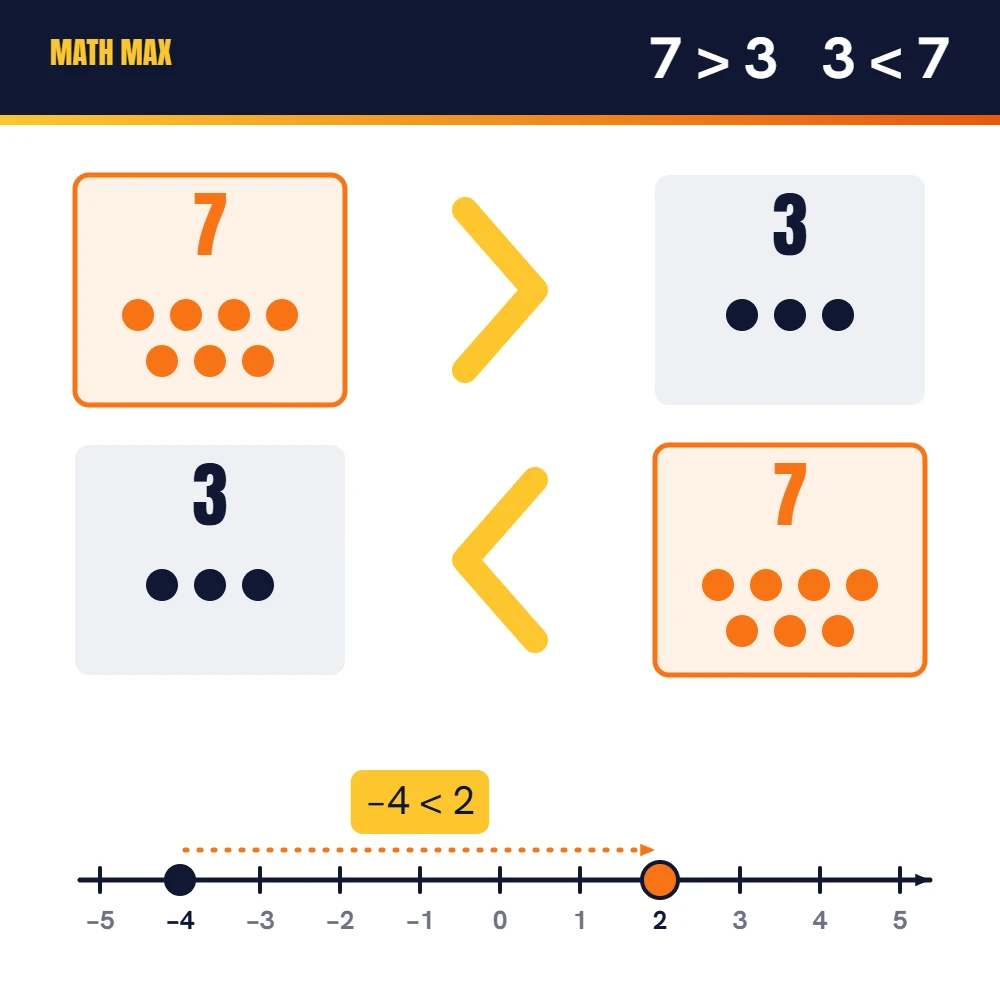
Both lines in the picture say the same thing. Which sign you write depends only on which number you put first.
Three visual tricks that help children
Different tricks click for different children, so it's worth trying more than one.
- The hungry mouth. Picture the sign as an open mouth, often drawn as a crocodile or a fish, that always wants to eat the bigger number. Many children like drawing teeth on it.
- Big side, small side. The sign is wide on one side and tiny on the other. The big side goes next to the big number, and the tiny point goes next to the small number.
- Two dots and one dot. Draw two dots next to the bigger number and one dot next to the smaller one, then join the two dots to the single dot. The lines make the correct sign.
A common stumbling point with the mouth trick is that children remember the mouth but forget which number it eats. Saying "it eats the bigger one" out loud each time helps it stick.
How do you read greater than and less than out loud?
Read greater than and less than signs from left to right, like a sentence. Start with the number on the left, say the sign, then say the number on the right. So 3 < 8 is read as "3 is less than 8", and 8 > 3 is read as "8 is greater than 3". Both describe the same fact.
Example
Read 12 > 5 and 5 < 12.
- 12 > 5 is read "12 is greater than 5".
- 5 < 12 is read "5 is less than 12".
The open textbook OpenStax Prealgebra 2e uses the same reading, with a < b read as "a is less than b" and a > b as "a is greater than b". Many children mix up the signs when they read from right to left, so it helps to point at each part as you say it.
How do you compare larger numbers and decimals?
To compare larger numbers, first count the digits. A number with more digits is bigger. If both have the same number of digits, compare them place by place from the left, and the first place where the digits differ decides which number is greater. For decimals, line up the decimal points and compare in the same way.
Example
Compare 4,512 and 4,521.
- Both have four digits.
- Thousands: 4 and 4, the same.
- Hundreds: 5 and 5, the same.
- Tens: 1 and 2. Since 1 < 2, the whole number is smaller.
So 4,512 < 4,521. Decimals cause more trouble, because a longer decimal looks bigger. Compare 0.5 and 0.45. Write 0.5 as 0.50, so both have two decimal places. Now 50 hundredths is more than 45 hundredths, so 0.5 > 0.45. If decimals are where your child gets stuck, the decimals game gives plenty of quick comparisons. Adding a zero at the end, as with 0.50, is the habit to build.
How do greater than and less than work with negative numbers?
With negative numbers, think of a number line. A number further to the right is always greater, and a number further to the left is always less. So −4 < 2, and −7 < −3, even though 7 looks bigger than 3. Among negative numbers, the one closer to zero is the greater one.
Example
Compare −7 and −3.
- On a number line, −3 is to the right of −7.
- Further right means greater, so −3 > −7.
- The same fact the other way round is −7 < −3.
A temperature of −3 °C is warmer than −7 °C, which is an easy way to check that the answer makes sense. The negative numbers game is a good place to get used to this once the basic signs are secure. A drawn number line next to the screen helps at the start.
What do ≥ and ≤ mean?
The sign ≥ means greater than or equal to, and ≤ means less than or equal to. The extra line underneath stands for the equals sign. So x ≥ 5 means x can be 5 or any number bigger than 5, and x ≤ 5 means x can be 5 or any number smaller than 5.
Example
A board game needs at least 2 players and at most 6. If p is the number of players, then p ≥ 2 and p ≤ 6. With 2 players, p ≥ 2 is true because 2 = 2. With 7 players, p ≤ 6 is false. The sign ≠ means not equal to, so 7 ≠ 6.
These signs lead straight into inequalities in algebra, where you solve for a range of numbers instead of a single answer. The inequalities game is the next step for older learners. The idea of the open side facing the bigger value stays exactly the same.
How can you practise comparing numbers at home?
The quickest way to practise is to make comparisons part of short, playful moments. Children need many quick examples, and saying each comparison out loud helps the signs stick. A few minutes at a time is plenty.
Ideas that need almost nothing
- Roll two dice, one each. The player with the greater number wins the round, and the winner writes the sign between the two numbers.
- Turn over two playing cards and ask which sign goes between them before anyone says the answer.
- Draw a number line on paper with numbers from −10 to 10, place two counters on it, and ask which is greater.
For a game that keeps the comparisons coming, the comparing numbers game turns each one into an attack. Pick the right sign and your fighter lands the hit.
Who invented the greater than and less than signs?
The signs < and > first appeared in a book on algebra by the English mathematician Thomas Harriot, published in 1631, ten years after his death. That's according to the history of mathematics archive MacTutor, which also notes that Harriot was not directly responsible for the book itself.
Example
Before the signs existed, writers had to spell comparisons out in words. Writing 1,000 > 999 takes a second, while the same idea in a full sentence takes much longer. Today the same two symbols are used in classrooms all over the world.
Big side to the big number is the only rule you need
Every comparison comes back to one idea. The open side of the sign faces the greater number, and the point faces the smaller one. Once that's secure, the same sign works for large numbers, decimals, negative numbers and, later, inequalities in algebra.
Train these next