You won't find riddles that depend on English jokes here. The puzzles are grouped by age, from about 5 to 14, and the answers come at the end of each group, with the reasoning, so you can explain them and not just check them. After the puzzles there are a few classroom routines that work well.
What are good math puzzles for ages 5 to 7?
For ages 5 to 7, the best math puzzles use small numbers and things children can picture or hold, like birds, legs or strawberries. Let them use counters, fingers or a quick drawing. At this age the point is to notice a pattern and explain it, not to get the answer fast.
Read each puzzle aloud. If a child gives a wrong answer, ask how they got it before you say anything. Often they'll spot the slip themselves.
- What comes next? 2, 4, 6, ?, 10
- There are 5 birds on a fence. 2 fly away and 3 more land. How many birds are on the fence now?
- How many legs do 2 dogs and 3 birds have together?
- Share 12 strawberries fairly between 3 friends. How many does each friend get?
- What comes next? 1, 1, 2, 2, 3, 3, ?
- I'm thinking of a number. If you add 3 to it, you get 10. What is my number?
Answers for ages 5 to 7
- 8, because the numbers go up by 2 each time.
-
- After 2 fly away there are 3 left, and 3 more makes 6.
-
- Two dogs have 8 legs and three birds have 6, and 8 + 6 = 14.
- 4 each. Hand the strawberries out one at a time, like dealing cards, and every friend ends up with 4.
-
- Each number comes twice before the next one starts.
-
- Count up from 7 to 10 on your fingers and you'll have added exactly 3.
Which math puzzles suit ages 8 to 10?
Children of 8 to 10 are ready for puzzles with more than one step, where a first guess can be tested and improved. Magic squares, number patterns and missing signs are a good fit. They practice addition, subtraction and times tables, but children tend to see them as a challenge rather than as practice.
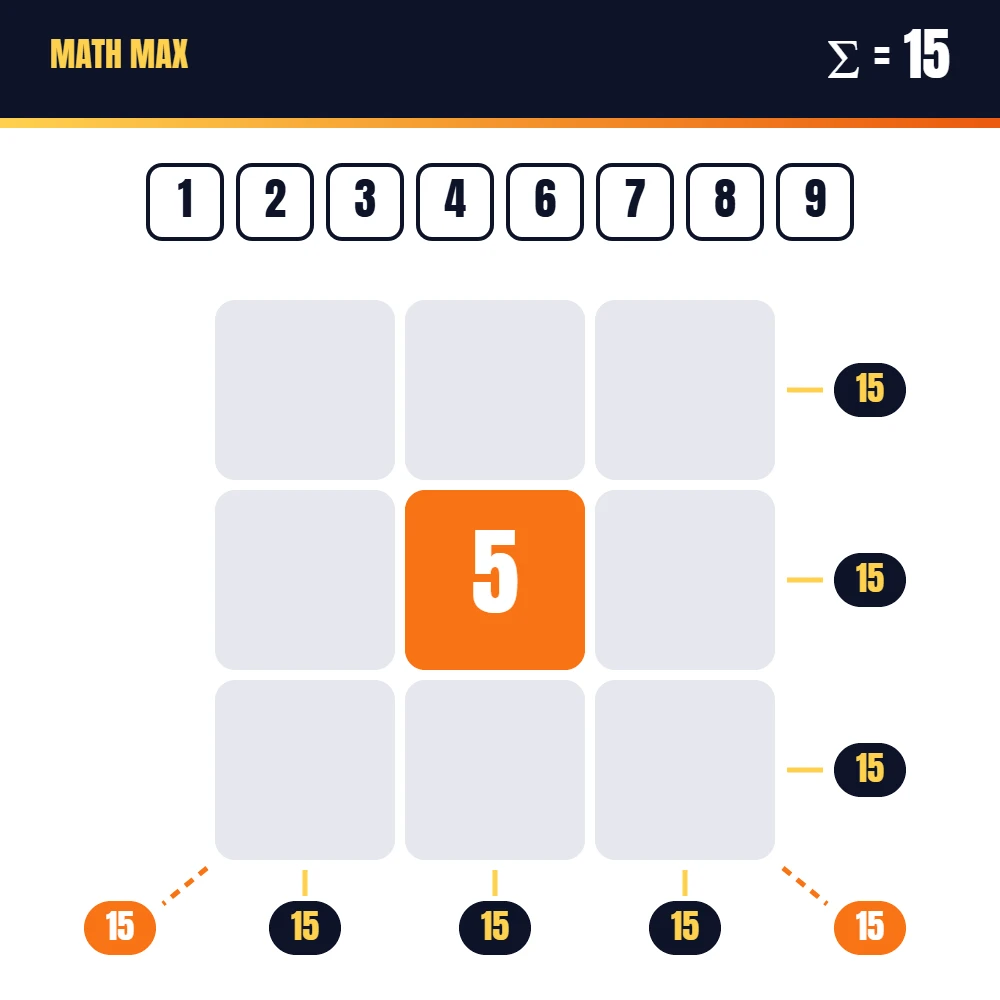
- Magic square. Put the numbers 1 to 9 in a 3 × 3 grid so that every row, every column and both diagonals add up to 15. The 5 goes in the middle.
- What comes next? 1, 4, 9, 16, ?, 36
- What comes next? 1, 1, 2, 3, 5, 8, ?
- Fill in the missing signs, using +, −, × or ÷. 6 ? 3 ? 2 = 4
- A farm has chickens and cows. Together they have 10 heads and 28 legs. How many cows are there?
- A book and a pen cost 110 coins together. The book costs 100 coins more than the pen. How much does the pen cost?
Answers for ages 8 to 10
- One solution has the rows 2, 7, 6, then 9, 5, 1, then 4, 3, 8. Any rotation or mirror image of it works too. If a child is stuck, tell them the even numbers go in the corners.
-
- These are square numbers, 1 × 1, 2 × 2, 3 × 3 and so on, so the gap is 5 × 5.
- 13, since each number is the sum of the two before it. Children who like this one will enjoy the Fibonacci sequence, which shows up in sunflowers and pine cones.
- There are two answers, 6 ÷ 3 + 2 = 4 and 6 ÷ 3 × 2 = 4. Finding the second one is a nice extra for fast finishers.
- 4 cows. If all 10 animals were chickens, you'd count 20 legs. The 8 extra legs belong to cows, and each cow has 2 more legs than a chicken, so there are 4 cows and 6 chickens.
- 5 coins. Most people say 10 first. Then the book would cost 110 and the two together 120, which is too much. A pen at 5 and a book at 105 make 110, with a difference of 100.
The magic square is old. A Chinese legend tells of a turtle that climbed out of the Luo River with this exact pattern on its shell. In China the square is still known as the Lo Shu.
Which math puzzles challenge ages 11 to 14?
At 11 to 14, puzzles can have many right answers, or reward a clever shortcut over long working. The four fours challenge, handshake puzzles and patterns in big numbers all work. Students have to test ideas, look for structure and explain a method, and a mixed class can work on the same puzzle at very different levels.
- Four fours. Use exactly four 4s and any of +, −, × and ÷, with brackets, to make every number from 1 to 10. You may also join two 4s to make 44.
- Ten people meet, and each person shakes hands once with every other person. How many handshakes are there?
- Add all the whole numbers from 1 to 100. Can you do it without adding them one by one?
- Three numbers in a row, such as 4, 5 and 6, add up to 48. Which numbers are they?
- What is the last digit of 2 multiplied by itself 20 times?
Answers for ages 11 to 14
- Here is one set. There are many others, and comparing them is half the fun.
- 1 = 44 ÷ 44
- 2 = 4 ÷ 4 + 4 ÷ 4
- 3 = (4 + 4 + 4) ÷ 4
- 4 = 4 × (4 − 4) + 4
- 5 = (4 × 4 + 4) ÷ 4
- 6 = 4 + (4 + 4) ÷ 4
- 7 = 44 ÷ 4 − 4
- 8 = 4 + 4 + 4 − 4
- 9 = 4 + 4 + 4 ÷ 4
- 10 = (44 − 4) ÷ 4
-
- Each of the 10 people shakes 9 hands, which makes 10 × 9 = 90. But that counts every handshake twice, once from each side, so the answer is 90 ÷ 2 = 45.
-
- Pair the numbers from the outside in. 1 + 100 = 101, 2 + 99 = 101, and so on. That gives 50 pairs, and 50 × 101 = 5050.
- 15, 16 and 17. Three numbers in a row always add up to 3 times the middle one, so the middle one is 48 ÷ 3 = 16.
-
- The last digits of 2, 4, 8, 16, 32 and so on repeat in a cycle of four, 2, 4, 8, 6. Since 20 is a multiple of 4, the last digit is 6. The whole number is 1,048,576.
Four fours has been around for well over a hundred years, and it still works because nobody gets stuck at the start. Almost everyone finds 1 and 2 quickly. The arguments start around 7 and 9.
How do you use math puzzles in the classroom?
Puzzles work best as a short routine that comes back every week, rather than a treat for the last lesson before a holiday. A five-minute warm-up, a puzzle of the week on the wall or a puzzle box for early finishers are easy to start. Let students think alone first, then compare ideas with a partner.
Teacher Donna Paul describes routines like these in an Edutopia article on logic puzzles in math class. Her students worked alone for the first minute and then shared their reasoning with a partner. She also kept a puzzle of the week on a small board, so students could choose to take it on.
A few practical points from teachers make a big difference.
- Use a visible timer for warm-ups, so the puzzle doesn't eat the whole lesson.
- Fast finishers usually want different work, not more of the same. A puzzle box gives them that.
- End with two or three students explaining different methods. That short discussion is where most of the learning happens.
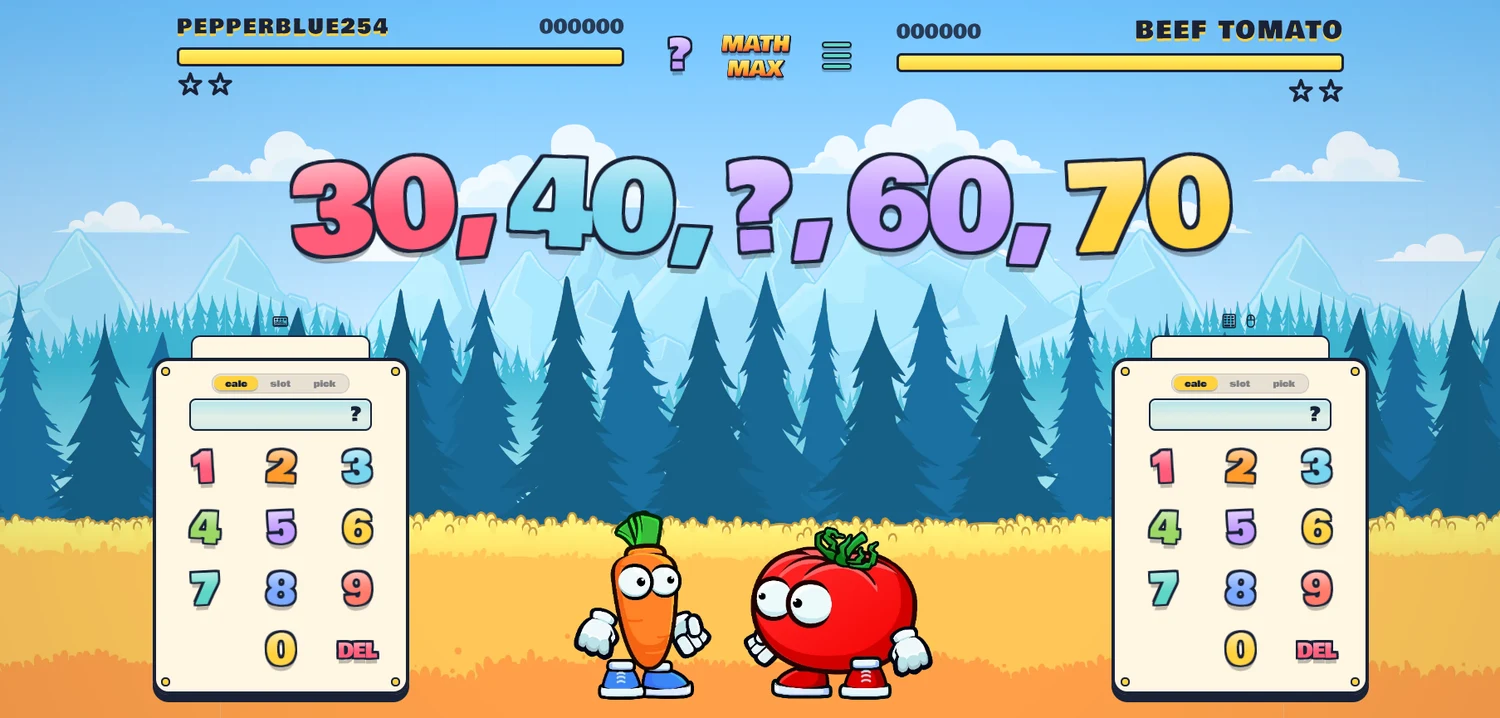
Number patterns make a quick warm-up, because one line of numbers on the board is enough to start a discussion. For a follow-up, a few rounds of the number sequences game ask students to find the missing number in a pattern, like the 30, 40, ?, 60, 70 round in the picture below. Teachers can run it with the whole class through Math Max for schools and keep it to the same five minutes.
Some schools want every activity tied to the curriculum, and puzzles are easy to match by topic. Sequences cover patterns, the farm puzzle covers multiplication, and four fours is a sneaky way to practice the order of operations.
Should you give the answer when a child is stuck?
Give a hint first, not the answer. A good hint points to a first step, such as drawing the problem or trying smaller numbers. If two or three hints don't help, walk through the solution together, then give a similar puzzle a few days later so the child can try the idea alone.
A simple ladder of hints works for most puzzles.
- Ask what they've tried so far.
- Suggest a strategy, like drawing it, guessing and checking, or trying smaller numbers.
- Give one piece of the answer, such as "the 5 goes in the middle".
- Solve it together, then hand over a similar puzzle.
Teachers don't all agree on how long children should struggle on their own. Long struggle without any feedback tends to end in frustration, or in children who are sure of a wrong answer. A short struggle, then hints, then a class discussion avoids both.
Do math puzzles help kids learn math?
Puzzles give children practice in something worksheets rarely ask for. They have to choose a method, test it and explain it. Good puzzles let every child make a start and still offer a real challenge. Teachers call these tasks low floor, high ceiling, and they suit mixed-ability classes well.
The evidence here is encouraging but modest. The Education Endowment Foundation's guidance on improving math for ages 7 to 14 recommends teaching strategies for solving problems, while noting that results in the research vary. So treat puzzles as one good habit among others, not as a magic fix.
A simple test helps when you choose a puzzle. If nobody in the class can start it, it's too hard. If nobody gets stuck, it's too easy.
The best puzzle is one every child can start and still get stuck on
Choose puzzles that every child can begin, and keep the harder ones for later. Leave time for children to explain how they solved them, because hearing two methods teaches more than one right answer. Keep it light, so that being stuck feels like part of the game.
Train these next