
On a number line, integers are the evenly spaced points you land on when you count forwards or backwards from 0. Numbers like 1/2, 3.5 or √2 sit in the gaps between them, so they aren't integers. Here's how to tell the difference, why zero counts, and how the sign rules for integers really work.
How do you know if a number is an integer?
A number is an integer if you can write it without a fraction or a decimal part. It can be positive, negative or zero. The textbook OpenStax Prealgebra 2e puts it simply, integers are the counting numbers, their opposites and zero. So 7, −7 and 0 are integers, while 7.5 is not.
Example
Try these quick checks.
- −12 is an integer, because it's the opposite of the counting number 12.
- 0 is an integer.
- 3.5 is not an integer, because it has a decimal part.
- 1/2 is not an integer.
- 8/2 is an integer, because 8/2 = 4.
- √9 is an integer, because √9 = 3.
- √2 is not an integer, because it's about 1.41.
The last few show a useful habit. Work out the value first, then decide. A number can look like a fraction or a root and still turn out to be an integer.
Is 0 an integer?
Yes, 0 is an integer. It sits in the middle of the number line, between the negative integers and the positive ones. Zero is neither positive nor negative, which OpenStax states directly. It is even, though, because 0 = 2 × 0, so it divides by 2 with nothing left over.
Are negative numbers integers?
Negative numbers are integers only when they have no fraction or decimal part. −5 and −100 are integers. −2.5 and −3/4 are negative, but they aren't integers. The same test works for every number, whatever its sign.
What's the difference between integers and whole numbers?
In most textbooks, whole numbers are 0, 1, 2, 3 and so on, with no negatives. Integers include all of those plus the negatives, −1, −2, −3 and so on. So −4 is an integer but not a whole number. Some books and dictionaries use "whole number" more loosely, so check the definition your child's school uses.
Example
Here's how the main groups fit inside each other.
- Natural numbers or counting numbers: 1, 2, 3, 4, …
- Whole numbers: 0, 1, 2, 3, 4, …
- Integers: …, −3, −2, −1, 0, 1, 2, 3, …
- Rational numbers: every number you can write as a fraction of integers, such as 1/2, −3/4 and 7 (which is 7/1)
Mathematicians write the set of integers as ℤ. The letter comes from the German word Zahlen, which means "numbers". You may also see ℕ for the natural numbers. Even the natural numbers have a small disagreement attached, because some books start them at 0 and others at 1.
Where do you see integers in real life?
Integers show up whenever you count up and down from a zero point. Temperatures below freezing, floors below ground level, depths below sea level and the goal difference of a football team are all integers that can be negative. In each case 0 is a reference point, not "nothing".
Example
The temperature is −4 °C in the morning and rises by 7 degrees by lunchtime. Start at −4 and count 7 steps up the number line, −3, −2, −1, 0, 1, 2, 3. The lunchtime temperature is 3 °C, so −4 + 7 = 3.
In a lift, the ground floor is often 0, the car park might be floor −2, and the fifth floor is 5. Going from −2 to 5 means travelling 7 floors, because 5 − (−2) = 7.
How do you add and subtract integers?
To add integers, picture a number line. Adding a positive number moves you to the right, and adding a negative number moves you to the left. Subtracting is the opposite of adding, so subtracting a negative number moves you to the right. That's why taking away a negative gives a bigger answer.
Example
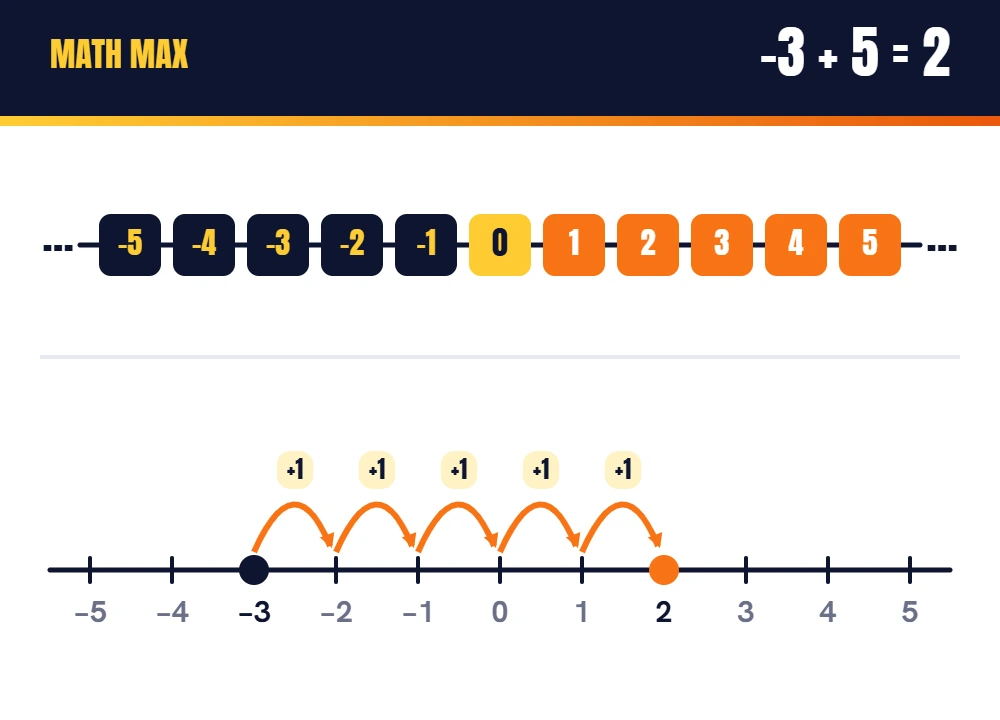
Work out −3 + 5. Start at −3 and take 5 steps to the right. You pass −2, −1, 0 and 1, and stop at 2. So −3 + 5 = 2.
A few more to try.
- −6 + 2 = −4, because 2 steps right from −6 lands on −4.
- −2 − 5 = −7, because 5 steps left from −2 lands on −7.
- 4 − (−3) = 7, because subtracting −3 is the same as adding 3.
Why does subtracting a negative make the answer bigger?
Subtracting means "what is the difference?". The difference between 4 and −3 on the number line is 7 steps, so 4 − (−3) = 7. OpenStax writes the general rule as a − (−b) = a + b. Many children get stuck on −5 + 4 because they see a plus sign and expect a bigger number. Starting at −5 and moving 4 to the right shows the answer is −1.
Why is a negative times a negative positive?
When you multiply two integers, the answer is positive if the signs are the same and negative if they are different. A negative times a negative is positive because of a pattern. Each time the first number goes down by 1, the answer changes by the same amount, and that pattern only continues if the answer becomes positive.
Example
Watch what happens to 3 × (−2) as the first number goes down by 1 each time.
- 3 × (−2) = −6
- 2 × (−2) = −4
- 1 × (−2) = −2
- 0 × (−2) = 0
- (−1) × (−2) = 2
- (−2) × (−2) = 4
Each answer is 2 more than the one before. To keep the pattern going past zero, (−1) × (−2) has to be 2. Another way to picture it is that multiplying by −1 turns you around on the number line. Turn around twice and you're facing the same way again.
Does dividing integers follow the same sign rule?
Yes. (−12) ÷ 3 = −4 and (−12) ÷ (−3) = 4, with the same rule about matching signs. There's one difference, though. Adding, subtracting or multiplying two integers always gives an integer, but dividing doesn't always. 8 ÷ 2 = 4 is an integer, while 7 ÷ 2 = 3.5 isn't.
How do you get faster with integers?
Speed with integers comes from doing lots of small calculations until the number line is in your head. In the negative numbers game, every attack is a quick sum with negative numbers, so children practise the sign rules while they're busy trying to win the fight.

The distance of a number from zero is called its absolute value, so the absolute value of −5 is 5. It's the next idea most learners meet after integers, and the absolute value game turns it into a series of quick rounds.
Integers are the numbers you can count to, forwards or backwards
Every integer is a step you can reach by counting from 0, to the right for positive numbers and to the left for negative ones. Zero sits in the middle and belongs to the group too. If a child can picture that number line, the rules for adding, subtracting and multiplying stop being rules to memorise and start making sense.
Train these next