Perfect squares and square numbers
Perfect squares are also called square numbers, and the two names mean the same thing. The number you multiply by itself is the square root, so 3 is the square root of 9.
Knowing the first perfect squares by heart makes square roots, fractions and the Pythagorean theorem much faster. Below you will find the full list from 1 to 100, the reason they are called squares, and simple checks to tell whether any number is a perfect square.
What are the perfect squares from 1 to 100?
There are 10 perfect squares from 1 to 100. They are 1, 4, 9, 16, 25, 36, 49, 64, 81 and 100, the squares of the whole numbers 1 to 10. Each perfect square in the list is the result of a number times itself, so 64 is 8 × 8 and 100 is 10 × 10.
The list of perfect squares from 1 to 100
- 1 × 1 = 1
- 2 × 2 = 4
- 3 × 3 = 9
- 4 × 4 = 16
- 5 × 5 = 25
- 6 × 6 = 36
- 7 × 7 = 49
- 8 × 8 = 64
- 9 × 9 = 81
- 10 × 10 = 100
You will also see these written with a small 2, such as 7² = 49. You read 7² as "7 squared". The small 2 is an exponent, and it means the number is used twice in a multiplication.
On a multiplication chart, all of these numbers sit on the diagonal from the top left to the bottom right. That diagonal is where a row and a column with the same number meet.
What are the perfect squares from 100 to 400?
The next ten perfect squares are the squares of 11 to 20.
- 11² = 121
- 12² = 144
- 13² = 169
- 14² = 196
- 15² = 225
- 16² = 256
- 17² = 289
- 18² = 324
- 19² = 361
- 20² = 400
Many learners find it worth memorizing these too, because 121, 144, 169 and 225 come up often in geometry and in square roots.
Why are they called square numbers?
They are called square numbers because that many dots or tiles can be arranged into a perfect square. Nine dots fit into a square of 3 rows and 3 columns, so 9 is a square number. Ten dots cannot make a full square, so 10 is not a perfect square. The side of the square is the square root.
Example
Start with 1 dot. Add 3 dots around one corner and you get a 2 by 2 square of 4 dots. Add 5 more dots around the corner and you get a 3 by 3 square of 9 dots. Add 7 more and you get a 4 by 4 square of 16 dots.
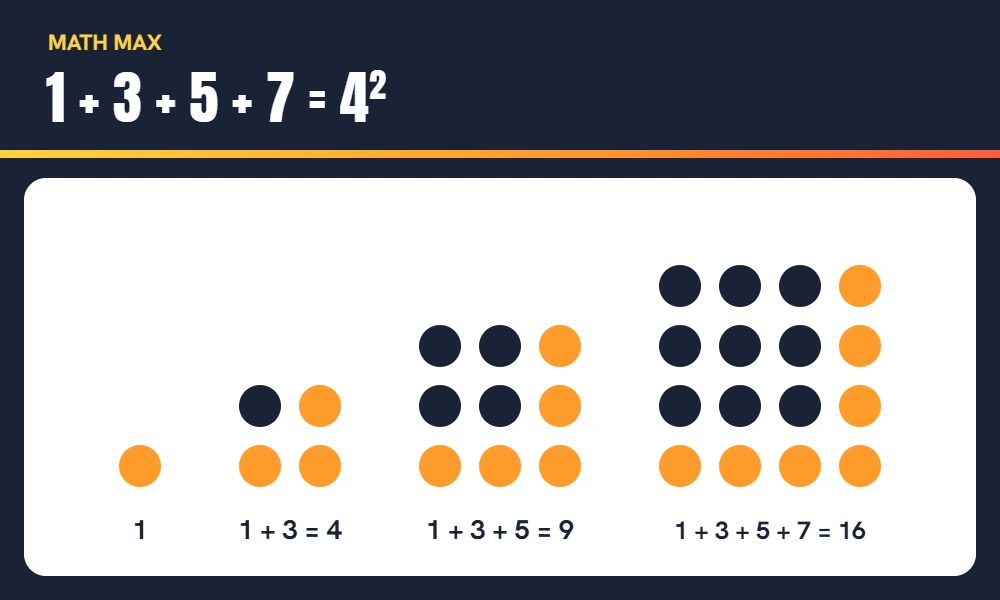
The diagram shows a pattern hiding in the list. The perfect squares are the sums of the odd numbers in order. So 1 + 3 + 5 + 7 = 16, and adding the first 10 odd numbers gives 100. The On-Line Encyclopedia of Integer Sequences lists this as a basic property of the squares. You can test it yourself with any row of dots.
The same pattern tells you how far apart two neighboring perfect squares are. From one square to the next, you always add the next odd number. From 7² = 49 to 8² = 64 is a jump of 15, which is 7 + 8.
How can you tell if a number is a perfect square?
The surest test is to find the square root. If the square root is a whole number, the number is a perfect square. For larger numbers, a few quick checks can rule a number out before you calculate anything. Look at the last digit, add up the digits, and count the zeros at the end.
Check the last digit
A perfect square can only end in 0, 1, 4, 5, 6 or 9. A number ending in 2, 3, 7 or 8 is never a perfect square. So 2,023 and 4,568 are out at once. This rule is stated in the square number entry on Wolfram MathWorld, which also lists the digit sum check below. Both rules hold for every whole number.
A good last digit does not prove anything on its own. The number 19 ends in 9, but it is not a perfect square. The last digit can only rule numbers out.
Add up the digits
Add the digits, and keep adding until you have one digit. This is called the digital root. For a perfect square, the result is always 1, 4, 7 or 9.
- 2,024 has digits 2 + 0 + 2 + 4 = 8. Since 8 is not 1, 4, 7 or 9, 2,024 is not a perfect square.
- 1,296 has digits 1 + 2 + 9 + 6 = 18, and 1 + 8 = 9. It passes, and in fact 1,296 = 36².
Like the last digit, this check can only rule numbers out. The number 13 has a digital root of 4, but it is not a perfect square.
Count the zeros at the end
A perfect square that ends in zeros always ends in an even number of them. 100, 400 and 3,600 end in two zeros and are perfect squares. A number like 1,000 or 40,000,000 that ends in an odd number of zeros can never be one.
Split the number into prime factors
A number is a perfect square exactly when every prime in its factorization appears an even number of times. This test is always right, so it is the best one for larger numbers.
For example, 784 = 2 × 2 × 2 × 2 × 7 × 7. The 2 appears four times and the 7 appears twice, so 784 is a perfect square. Pair the factors up and you get its square root, 2 × 2 × 7 = 28. By contrast, 72 = 2 × 2 × 2 × 3 × 3 has three 2s, so 72 is not a perfect square.
How do perfect squares help with square roots?
Perfect squares are the numbers whose square roots are whole numbers. If you know the list, you know their square roots at once, so the square root of 81 is 9 and the square root of 144 is 12. For any other number, the two nearest perfect squares tell you between which whole numbers the square root lies.
Example
Estimate the square root of 50. The nearest perfect squares are 49 = 7² and 64 = 8². Since 50 lies between them, its square root lies between 7 and 8. Because 50 is very close to 49, the square root is just above 7. A calculator gives about 7.07.
Perfect squares also simplify square roots. The square root of 72 is the square root of 36 × 2, and since 36 is a perfect square, that becomes 6 times the square root of 2.
Quick recall of the squares and their roots is something you build by using them, not by staring at a list. In the square roots game, every attack in a Math Max fight is a square root problem, so the list above turns into fast answers. The exponents game covers squares, cubes and other powers in the same way. Both are free to play in the browser.

Is 0 a perfect square, and can a perfect square be negative?
Yes, 0 is a perfect square, because 0 × 0 = 0. Many lists start at 1 because 0 is a special case, but it fits the definition. A perfect square cannot be negative, because a number times itself is never negative. Both 5 × 5 and (−5) × (−5) give 25.
Example
That last fact means every positive perfect square has two square roots. The number 49 has the square roots 7 and −7, because both 7 × 7 and (−7) × (−7) equal 49. When people say "the square root of 49", they usually mean the positive one, 7.
A common mistake is to think −49 is a perfect square because 49 is. No whole number times itself gives −49, so it is not. The number 1 is a perfect square too, because 1 × 1 = 1.
Can a fraction or a decimal be a perfect square?
Some textbooks also call a fraction a perfect square when its top and bottom are both perfect squares, such as 4/9 = (2/3)². In most lessons, though, perfect squares means whole numbers only, and that is the meaning used in this article.
What are some tricks for squaring numbers quickly?
Two patterns make many squares easy in your head. For a number ending in 5, multiply the tens digit by the next number up and write 25 after it. For a number next to one you know, add the two numbers to the square you know. You can check both by multiplying the numbers out.
Example
Squaring numbers that end in 5:
- 35²: 3 × 4 = 12, then write 25, so 35² = 1,225.
- 65²: 6 × 7 = 42, then write 25, so 65² = 4,225.
- 85²: 8 × 9 = 72, then write 25, so 85² = 7,225.
Squaring the next number up:
- 21² = 20² + 20 + 21 = 400 + 41 = 441.
- 31² = 30² + 30 + 31 = 900 + 61 = 961.
These tricks work in every language, because they rely on patterns in the numbers and not on words. More shortcuts like these are in our guide to mental math tricks. Try one trick at a time until it feels automatic.
Perfect squares are the numbers that make a full square
A perfect square is any whole number you can lay out as a complete square of dots, which is the same as a number times itself. Learn the ten from 1 to 100, then use the last digit, the digit sum and the zeros to rule numbers out quickly. When you need certainty, the prime factors or the square root give the final answer.
Train these next