
The sphere formula in one line
The formula for the volume of a sphere needs only one measurement, the radius. You cube the radius, multiply by π, and then multiply by 4/3. The answer is always in cubic units, such as cm³ or m³, because volume measures the space inside a solid.
How do you find the volume of a sphere from the radius?
To find the volume of a sphere from the radius, put the radius into V = 4/3 πr³. First cube the radius (r × r × r). Then multiply by π and by 4/3. You can multiply in any order. Write the answer in cubic units, and keep π exact until the last step for the most accurate result.
Example
A ball has a radius of 3 cm.
- Cube the radius. 3 × 3 × 3 = 27.
- Multiply by 4/3. 27 × 4/3 = 36.
- Multiply by π. V = 36π cm³.
- Use a calculator for a decimal answer. 36π ≈ 113.1 cm³.
36π cm³ is the exact answer. Rounding π to 3.14 too early gives 113.04 cm³, which is close but not the same.
How do you find the volume of a sphere from the diameter?
To find the volume of a sphere from the diameter, halve the diameter first to get the radius, then use V = 4/3 πr³. The radius always runs from the center to the surface, while the diameter goes all the way across. Some people use the equivalent form V = πd³/6, which gives the same result.
Example
A ball has a diameter of 10 cm. The radius is 10 ÷ 2 = 5 cm. Then 5³ = 125, and 125 × 4/3 × π ≈ 523.6 cm³. The short form gives the same number, because π × 1000 ÷ 6 ≈ 523.6 cm³.
The step from diameter to radius is the same one you use for the circumference of a circle when a problem gives the distance across. Make it a habit to write "r = ..." before you touch the formula.
How do you change cm³ into litres?
One litre is exactly 1000 cm³, so divide a volume in cm³ by 1000 to get litres. The 10 cm ball holds 523.6 ÷ 1000 ≈ 0.52 litres. A larger ball with a diameter of 24 cm has a radius of 12 cm, and 4/3 × π × 12³ ≈ 7238.2 cm³, which is about 7.24 litres.
How do you find the radius of a sphere from its volume?
To find the radius of a sphere from its volume, run the formula backwards. Multiply the volume by 3, divide by 4π, and then take the cube root. In symbols, r = ∛(3V ÷ 4π). The cube root undoes the cubing, in the same way that a square root undoes squaring.
Example
A round water balloon holds 1 litre, which is 1000 cm³.
- Multiply by 3. 1000 × 3 = 3000.
- Divide by 4π. 3000 ÷ (4 × π) ≈ 238.73.
- Take the cube root. ∛238.73 ≈ 6.20 cm.
So a sphere that holds 1 litre has a radius of about 6.20 cm. You can check by going forwards again. With r = 6.2035 cm, the formula gives almost exactly 1000 cm³. If cube roots feel shaky, a few rounds of the exponents game make cubes like 27, 64 and 125 familiar enough to spot on sight. Then ∛27 = 3 and ∛125 = 5 feel as easy as square roots.
What is the volume of a hemisphere?
A hemisphere is half a sphere, so its volume is half of 4/3 πr³, which is 2/3 πr³. Use the radius of the flat circular face. For a hemisphere with a 3 cm radius, the volume is 18π cm³, or about 56.5 cm³, exactly half of the 36π cm³ sphere.
In word problems, a bowl or a dome is often a hemisphere. If a problem asks how much water fits inside a bowl, use the inner radius.
Where does 4/3 πr³ come from?
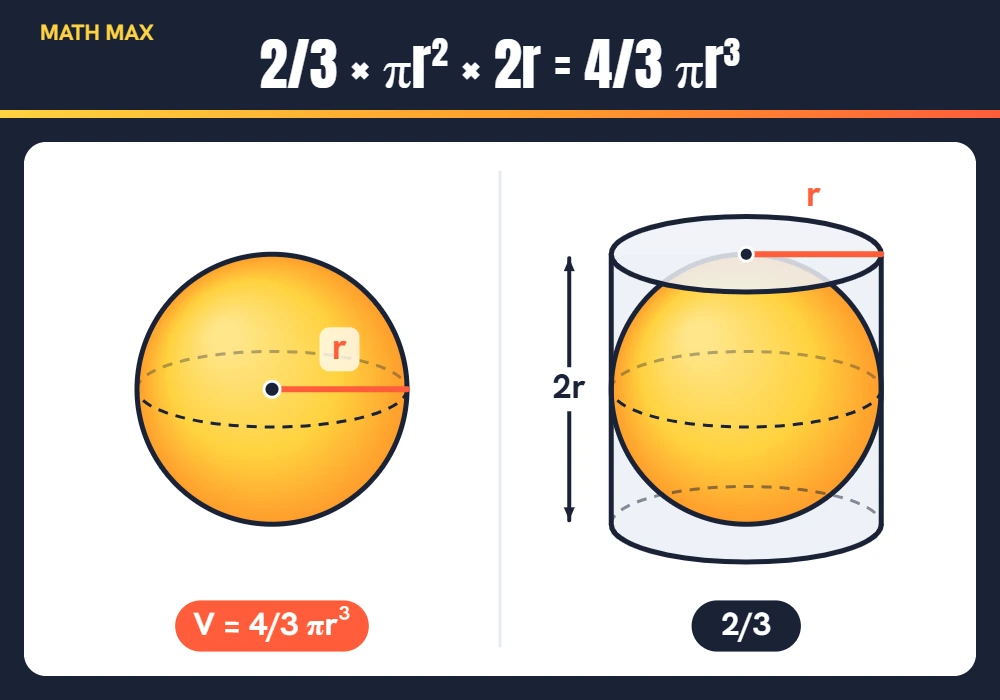
The 4/3 comes from a result proved by Archimedes, the Greek mathematician of Syracuse. He proved that a sphere fills exactly two thirds of the smallest cylinder that holds it. That cylinder has volume 2πr³, and two thirds of 2πr³ is 4/3 πr³. The fraction is simply what is left after that comparison.
The diagram shows both ideas. On the left is a sphere with its radius r and the formula V = 4/3 πr³. On the right, the same sphere sits snugly inside a cylinder with radius r and height 2r, and the label 2/3 shows how much of the cylinder the sphere fills. The line at the top, 2/3 × πr² × 2r = 4/3 πr³, sums up the whole argument.
Example
Take the 3 cm sphere again. The cylinder around it has radius 3 cm and height 6 cm. With the method for the volume of a cylinder, its volume is π × 3² × 6 = 54π cm³, about 169.6 cm³. Two thirds of 54π is 36π cm³, exactly the sphere's volume from earlier.
Archimedes valued this result so highly that he asked for a cylinder enclosing a sphere to be placed on his grave. According to the history collected by New York University's Courant Institute, the Roman writer Cicero found that grave in Sicily in 75 BC by spotting a column topped with a sphere and a cylinder. Over two thousand years later, the same picture is still the clearest way to remember the formula.
How do a cone and a sphere fill a cylinder?
There is a second way to see the 4/3. Take the same cylinder, with radius r and height 2r, and a cone with the same base and height. A cone always holds one third of its matching cylinder, so the cone holds 2/3 πr³. The sphere holds 4/3 πr³. Together they hold 2πr³, which fills the cylinder exactly.
This is how the open lesson by Illustrative Mathematics, hosted on LibreTexts, builds the formula. Pour water from the cone and the sphere into the cylinder and it fills to the top. So the volumes of the cone, the sphere and the cylinder are in the ratio 1 to 2 to 3. With r = 3 cm, that is 18π, 36π and 54π cm³.
Why is the radius cubed?
Volume has three dimensions, so the formula must multiply three lengths. That is why r appears three times. It also means size grows fast. Double the radius from 3 cm to 6 cm and the volume grows from 36π to 288π cm³, which is 8 times as much, because 2 × 2 × 2 = 8.
How are the volume and surface area of a sphere related?
The surface area of a sphere is A = 4πr², and the volume is V = 4/3 πr³. The area measures the skin of the ball in square units, while the volume measures the space inside in cubic units. You can get the volume from the area by multiplying by r and dividing by 3.
That last fact has a neat picture behind it. Imagine cutting the sphere into many thin pyramids, each with its tip at the center and its base on the surface. Each pyramid has height r, and a pyramid's volume is one third of base times height. Add up all the bases and you get 4πr², so the volume is 1/3 × 4πr² × r = 4/3 πr³.
A common question is why the area has a 4 while the volume has 4/3. The 1/3 comes from the pyramids. For the 3 cm ball, the area is 36π cm² and the volume is 36π cm³. The matching number is a coincidence of r = 3, and the units show they measure different things.
What mistakes do people make with the sphere formula?
The most common mistake with the sphere formula is using the diameter in place of the radius. Other frequent slips are multiplying the radius by 3 instead of cubing it, mixing up the area and volume formulas, and forgetting cubic units. Each one is easy to catch with a quick check of what was put into the formula.
- Diameter instead of radius. With a 6 cm diameter, using 6 as r gives 288π cm³ instead of 36π cm³. That answer is 8 times too large.
- Times 3 instead of cubed. r³ means r × r × r, so 3³ is 27, not 9.
- Squaring instead of cubing. The area of a circle uses r², but a sphere is three dimensional. Volume needs r³.
- Wrong units. Volume is in cm³ or m³, never cm². Convert all lengths to the same unit before you start.
- Rounding too early. Keep π and the cube exact until the final step.
A quick sense check catches most of these. A sphere always holds a little more than half of the cube around it, because 4/3 π ÷ 8 ≈ 0.52. The 3 cm ball sits in a cube of 6 cm sides, which holds 216 cm³, and 113.1 cm³ is just over half of that.
Formulas like this one stick when you use them often with real numbers. Spotting the radius, cubing it and judging whether an answer is sensible all get quicker in the geometry game, where every attack in a Math Max fight is a problem to solve. A few short rounds make the next test question feel familiar.

A sphere is two thirds of its cylinder, and that gives 4/3 πr³
To find the volume of a sphere, find the radius, cube it, and multiply by 4/3 and π. To go backwards, multiply by 3, divide by 4π and take the cube root. For half a ball, use 2/3 πr³. Where the 4/3 comes from is the result Archimedes asked to have on his grave. A sphere fills two thirds of a cylinder of radius r and height 2r, and two thirds of 2πr³ is 4/3 πr³.